I was standing there, looking into the bathroom at my most tender child while he sat on the toilet, and I responded like any mom would– like I thought he would want me to respond.
“Yeah, buddy, you’re one of the coolest people I know!”
Silence. So much toilet paper.
“I don’t think I’m cool. I just want to have friends who aren’t cool, like me. Because I like who I am! And I just want them to like who they are. And I could like who I am.”
“You know what, you’re totally right and that actually makes more sense. I’m not cool either and it feels really good to be around people who just like who we are. Wow, that’s a really wise thing you said.”
Flush. Silence. So much toilet paper.
I love this kid so much it hurts. I’m wild about him. Tonight after family devotions, he preached a sermon in some of the straightest language I’ve ever heard about how the meanness inside of us is violent toward other people. His delivery is at times hard to follow because he weaves in and out of teaching and illustrations (accompanied by an entire scene acted out where he is all the characters). That’s how it was tonight, but every time Pat or I thought to insert a teaching point or help him along, he just kept right on going and by the end of his rambling we were both affirmed with wide eyes, “Wow, that’s really incredible.”
The funny thing is, he’s asked this before about being cool and I always emphasize just how cool he, in fact, truly is. But I know now we weren’t speaking the same language. He said “cool” and I heard “that invisible quality that pushes some people to the fringes and keeps some of them close to the center” and assumes that the center is where we all want to be.
I learned a lesson about language, looking at my boy on the toilet tonight. I need to listen more. Ask more questions. Make less assumptions. And, if I’m looking for it, the lesson might be for my spirit, too.
We decided to naturescape for the birds and the bees, in the beginning. Planting native wildflowers, clover and grasses on top of crunchy pecan leaves that would eventually be mulch. But pecan leaves are a pain. They start falling long before the autumn equinox, when trees have the nature’s okay to turn color and create the palette we stand in front of for family pictures. They cover our lawn in one way or another for most of the year, so naturescaping meant peacemaking with the pecans.
I’m not quite there yet (at peace with the pecans), but we did watch fritillary butterflies grow from skinny ‘lil babies to chrysalis plump. We noticed wrens and cardinals and mourning doves and mockingbirds and eastern towhees and tufted titmouses (titmice?) and downy woodpeckers. And we noticed a handful of other birds in different seasons, sitting early on the front steps in the morning. Listening. Is it nature taking back our yard as a habitat or is it just that I am listening?
Maybe it is both.
Some of the neighbors don’t mind. Actually, one of our sweet neighbors is a designated wildlife area and another has a 10 year plan to reclaim their yard to benefit the ecosystem where we live. So, we’re not the first with the idea. We’re just doing our best with free cardboard and harvested seeds and letting those blasted pecan leaves help where we can’t. They are cover for little insects and they are food for the ground and eventually compost to create a rich mix of soil for those little native seeds to grow.
I can’t help but think of native things. The idea that something– a plant or a person or a bird– belongs somewhere. This whole wide world in the mind of its Creator– with rocks carved out for waterfalls and mountains capped with snow and long, flat stretches of flowing wild grasses– is full of places and spaces designated specifically and uniquely to be a home, a place of belonging for something or someone. Cardinals and monarch butterflies and arctic foxes– they all have a sense of where they are supposed to be, to grow, to hunt, maybe even to die.
Humans are a bit more complicated. And not the least because our whole existence has been displacing people and plants and primates to make room for our ideas and inventions and ill-motivated conquests. We are not the world’s next best thing. We show up on the shores of places and we destroy. If we look at the long history of humanity, stretching back even further than the disasters of European explorers, we find destruction at the beginning or ending of every story. I’m no history expert, but as our home studies ancient worlds and middles ages, the stories all start to sound very similar.
I have a few moments now, while Pat puts finishing touches on our free book library out front. The cicadas push back the quiet and I wonder: what is native to our hearts? What belongs there, originally before the sins of self started to eat us from the inside? What has been choked out by invasive species that someone told us would be good to plant? What has been a nice, Bermuda grass landscape that has made my heart uninhabitable for the good, wild fruits to grow?
Thankfully, God is both the prologue and the epilogue to the books of history. He is before and after every place of destruction, inviting us into redemption season. Like a forest decimated by a fire, God invites us into the miracle of something new, green, and good growing up from the ashes of human destruction.
The analogies blur and my mind shakes back to our neighborhood picnic in an hour. Carrots, tomatoes, should I pack the BLT’s sitting on the table since we haven’t eaten lunch yet? I need to pick up my friend’s kids and find a cooler…
I do wonder if there is a place on this earth that a human feels “native.” Does that exist uniquely for each human or am I dreaming?
We started naturescaping for the birds and the bees, but maybe it is for my brain. Maybe I need to ask questions about why things are how they are and what needs to be ripped out. Maybe I need to let the soil inside rest so I can see what might grow when given the chance. Maybe naturescaping is a thing that can happen on the inside, too.
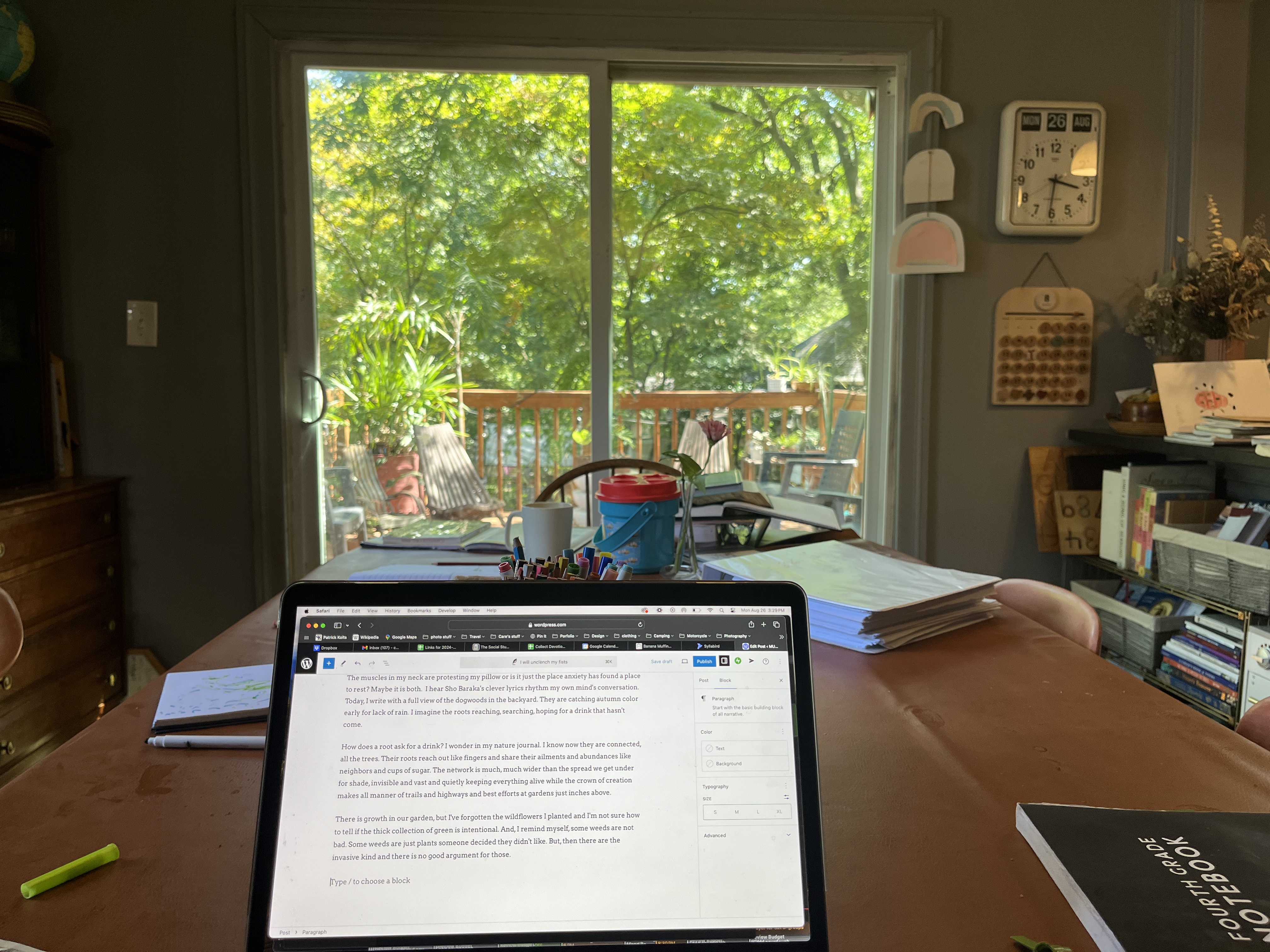
The muscles in my neck are protesting my pillow. Or, is it just the place anxiety has found to rest? Maybe it is both. I hear Sho Baraka’s clever lyrics rhythm my own mind’s conversation. Today, I write with a full view of the dogwoods in the backyard. They are catching autumn color early for lack of rain. I imagine the roots reaching, searching, hoping for a drink that hasn’t come.
How does a root ask for a drink? I wondered in my nature journal last week. I know now they are connected, all the trees. Their roots reach out like fingers and share their ailments and abundances like neighbors and cups of sugar. The network is much, much wider than the spread we get under for shade, invisible and vast and quietly keeping everything alive while the crown of creation makes all manner of trails and highways and best efforts at gardens just inches above.
There is growth in our garden, but I’ve forgotten the wildflowers I planted and I’m not sure how to tell if the thick collection of green is intentional. And, I remind myself, some weeds are not bad. Some weeds are just plants someone decided they didn’t like. But, then there are the invasive kind and there is no good argument for those.
I sketched a fly and a mosquito today as I sat with Foster for Science class. When my mind wants to make the wrong noise– to mirror the droop of my shoulders and the resignation in my throat– I look and listen for an invitation to the present moment. And there is always something. The leaves dancing in shadow on the deck chairs. Blue jays and cardinals and wrens chatting in the morning. We compare notes and sketches and try to figure out if I placed the legs in the right place, or are they arms? Feelers? Stingers? His web is an abstract attempt and I shoo away his apologies and disclaimers to pronounce it good.
And I wonder if he questions the authority I have to pronounce anything good. And he’s right. I don’t have any. I’m just a person.
Last night, I was sharing this idea I had with someone… where we would gather a list of questions from kids and then find real humans in our networks who could answer their questions. The idea, of course, is that within our networks we have vast, beautiful storehouses of knowledge and we could have our question answered by a human with eyeballs instead of a search bar with an interface.
“That’s so cool! What would your areas of expertise be?” he asked, like a gentle giant of fairy tales. Because, well, he is quite tall.
And I froze. I’m almost 40 and I am actually speechless when it comes to what I have to offer. Isn’t that funny? I mean, it’s hard to package “been rescued from a hike on a mountain where wild pumas roam free” and “taken multiple rides in cars with strangers” and “frequently attends theology and philosophy conferences without knowing a soul, not for a ed. requirement but just because” and “loves youth ministry, loves to dance” and “has kids, interest in spiritual formation.”
What I said was, “I’m not really sure. I have lots of questions! I just learned today that the dynamic of slavery in the Greco-Roman period could really change how we read Bible passages about freed people and how they relate to former owners and, therefore, how the message of the Gospel looked like an alien religion because it united people across classes in a way that nothing had ever done before. I’m interested in that!”
As I write that, I realize that what I said last night was more like, “Um, I learned this thing about Greco-Romans… interesting.. reading Ephesians…”
Does anyone have imposter syndrome about being human? I always think of Satan holding out some delectable sin– something sparkly and sinister and obvious. But, lately (always), it seems Satan has taken a more subtle tone with me. His garden question sounds more like, “But, were you actually worth making, compared to all this other glory He made? Did He really forgive you? Has God given you anything good to offer?”
And to be honest, there’s a lot of evidence stacked against me. My anger with the kids, my impatience with the ticking minutes, my resignation after a bad hour of the same work I was made to choose. It’s self-sabotage and Satan’s behind it. So, I speak it to the leaves and the sunshine on the dancing philodendron and the flies hovering above the dried smoothie on the table.
It’s this song, the bridge especially. And, there is no more time so this will publish unfinished but with these incredible beautiful harmonies.
“Ugh! Don’t you think it’s just so frustrating that we can never actually hug?!”
She’s acting out the question like it’s a modern dance prompt. “I mean, we’re just covered in molecules and there’s no real way that you… I mean the real you can really hug the real me! We’ll always just be separated by our skin!”
I’m not sure if I get the sweats because she’s so like me and I can so clearly visualize the mountains she’s climbing in her head OR if I get the sweats because she’s so unlike me which means there is a whole different set of mountains in there. Either way, I get overwhelmed by the barrage of questions and thoughts and the speed which is eerily similar to Rory from that one show I never watched in high school. The whole business of “we’re hugging but we’re not” was too existential for the post bedtime moment when it was introduced, so I shooed her off and snuggled into the end of one of three books on my nightstand.
Tonight, we walked the Beltline in search or Kombucha. Just two nerdy ladies making loud commentary on everything from fall weather to friendships to socially acceptable fraternizing.
“What’s singles night? Who goes to it? If you can get drunk on alcohol why do you drink it?” And she interrupts her own thoughts– “Oh, mom look! That place opened up! We’ve been waiting for it to open and now it is.. oh and looks like kind of a hula theme, okkkk! Oh, there’s the climbing gym. I sure love that place. And also why are there so many memberships but they are so expensive? You know, in heaven that will be so cool…
“Oh, you mean we will have all the memberships?”
“There won’t be any because we will all be in the same club!” I smile and she reaches for my hand. Now, we’re back to fall weather and sweaters and, oh! Here we are again. Back at molecules hugging.
“But, mom it really is awful that I’ll never actually be able to hug you. Like, really hug you, because we are just covered in skin and molecules and… ugh!”
“Wait, so you want our bones to hug? Our blood? What is it you envision hugging that would be more me than with my skin on?”
I was pushing, prodding… not because I knew what she would say and definitely not because I knew the answer (who even does know if molecules hug?). Today, she learned about dust mites (thank you Science class for introducing us to a world of terrors we cannot see) and she’s convinced we are all being “hugged” by tiny, terrible insects most of the time. Gross. But no, I think I was pushing because I was genuinely curious about where her thoughts would land.
“No, not blood and bones! I don’t know… Maybe, I don’t know, maybe I wish our souls could hug! Is that it? Like I just really think there is so much in between us kind of.”
“That’s it!” I said maybe a little too loud but it was okay because the DJ at the singles night was bumping. “I think I get what you’re saying!” And all at once we both summited a mountain in cozy sweaters in our separate brains and I realized God is seeing me, loving me, tending me, through the mind of this exquisite young lady. And I can see her a little bit more clearly in all her bursting, 9-year-old glory.
Indeed, what a wonderful day it will be, Zella Ruth, when our souls can finally hug.
There is no one on my lap, no one honking my nose or jungle gymming my back or gripping single strands of my hair with tiny, dimpled fingers. Adults crowd tables that look like high school chemistry class, but everyone is spaced out in socially appropriate bubbles and no one is doing experiments. I sit with three vacant chairs, staring at the exposed ceiling and pretend to vibe to the relevant music obscuring human conversations and clinking keys.
Caroline.
I am always too ambitious about being alone. My bag is stuffed with luxuries – Lord of the Rings, computer, daily liturgy, journal and some pens. I open a tab to make a list about all the things and it overlaps my stream of consciousness: articulate our family’s approach to discipline, write/rewrite a social media post, finally get more garlic at the grocery store for goodness sakes, breakdown our budget to weekly cashflow, look at houses for sale with/without boards on windows, think a whole thought, look through emails for things a normal human would have responded to already, reach out to realtors and lenders, look up “what to say to realtors and lenders” on community resource pages, decide whether my kids will ever be the kind of kids who wear real pajamas, write something down with a pen, look adult and confident and busy and important, watch people for a relevant reference, drink something all the way at the temperature it was when I ordered it, ̶w̶r̶i̶t̶e̶ ̶a̶ ̶b̶o̶o̶k̶, , make a plan to write a book.
…
Days later, here I am again in the freedom of alone at a different coffee shop, this time in our neighborhood. We – my neighborhood and me – are less cool and more practical. Aluminum folding chairs, computer, coffee, days-old hair and I think I slept in this shirt. I sit by the window and try to still my streaming thoughts, try to distill a sentence or a political commentary or even return to some of the list left unchecked from my last moments alone. But, I also have a dentist appointment this morning and I took too long ordering that ice coffee…
…
Again, alone. I came on my bike today, breathing the wet that comes after rain and feeling different muscles work to keep me in motion. My body battles back at me – creaking out something about, “use me more, not less.” Ok, I say under my breath, and I tilt my head toward giant, shining magnolia leaves and lean in so my shoulders can feel the rhythm of my pedaling as I duck under a flowering tree that hovers over the road. Morning is good for yard work and neighbors are in front lawns and on porches. I smile and my hellos surprise me. The world sounds so fine without my voice in it, with just the crackling neighborhood morning sounds. I beg my arms not to surrender to the weird fungus that appeared in the crease of my elbows. Did I sleep last night? My hands kept feeling like eczema fire and I remember flopping around with Foster – trying to get him to tell me what the trouble was, but our conversation was half-asleep. Must not have been serious because he woke up happy at 6 am.
Being human is broken.
Some people, I guess, can sometimes feel like everything is kind of okay. Like– maybe the world isn’t perfectly ordered, but their lives seem to be and it feels good. I’m not one of those people, or at least I can’t remember ever being that person.
I like the tension of longing. I think I even long for it. Maybe the act of longing sets me squarely in the present but connects me beyond it – recognizing deep in my spirit that all is not well right now, but it will be. It has been. It is in heaven. From night’s groggy end to it’s dusky beginning, I busy myself inside the ordinary moments while searching for that unnameable something that connects me outside them.
“There have been times when I think we do not desire heaven, but more often I find myself wondering whether in our heart of hearts, we have ever desired anything else. . . . It is the secret signature of each soul, the incommunicable and unappeasable want, the thing we desired before we met our wives or made our friends or chose our work, and which we shall still desire on our deathbeds when the mind no longer knows wife or friend or work.” C.S. Lewis in The Problem of Pain
I am present in my work – grabbing the leftover “pet elephant food” [marble] before it hits Foster’s lips, attempting to answer, “how did all the words get in there – in the Bible?” with some kind of pure simplicity, clean then dirty dishes and splattered stovetop and worm hunts and porch swings and toy baskets and sweat snuggles and the exhausting explanations about kindness coming from the heart.
…
I am home now, both children covered in carrot-berry smoothie. We take turns swaying in front of all seven windows. I spin for an applause of giggles. Beauty, delight, magic.
“But, I wasn’t hitting Mama! I was just patting.” “It was an accident, I think” “I wasn’t trying to…” But what was in your heart, babe? “Anger.”
I can see her eyelashes, all of them resting on her cheeks, when she says that last word. We heave breaths together, sweat mingled on all the arms. Yes, sweet girl. When there is ugly anger inside us it is incredibly hard to be kind. Almost, even impossible. She ducks into my skin, curls up and whispers, “I’m jealous.” I know, I say. And I hold them both like two wiggly fish on my lap on the floor in afternoon glow of all the front windows.
It is broken to be human and it is human to be broken.
And the bravery of a small life is to be about the work of restoration in the present moment, because of / in light of / in search of that desire that is hidden inside all of us. Eternity. It is saying YES to victory in Jesus by claiming His redemption over spilled milk and gentrification and humans who are called illegal. It is acting out that redemption in all the ordinary ways that callous our hands, not measuring a moment or a person or a question or a detour in light of its earthly value. The bravery of a small life is longing that all would be made well, knowing it is in Christ, and weighing the value of our days on the scale of His Kingdom come.
And I think I’m going to write a book about that.
**And that was 5 years, 2 kids, one house and a whole lifetime ago.**
Light dapples the deck and backdrops the August cicada song. The kids are loudly protesting quiet time and Postal Service serenades me with the windows open to the first hint of autumn cool breeze. “I was finally seeing, I was the one worth leaving.” Depravity is an idea with maybe too much mental baggage in my mind. Tulips, for me, should always and forever be considered for their beauty and elegance and never for their acronymic abilities. But, there are no tulips right now. My last zinnias are fighting for drinks in this drought stretch, reaching up at the very corner of our yard for the best light. They are bedraggled and glorious all at once.
When we started our very novice journey in landscaping, we thought “we are green people, not flower people.” The thought shames me now, but I will own it because then I know I’ve grown! My grandma, for years, wrote to all of her grandchildren on notecards that she made from pictures she took of her flowers. I almost said “her prize flowers” but they were all her treasures. She paused to notice each one blooming, sometimes letting just the bloom live in a vase inside to extend her viewing of it. But, she loved them all the same and though the picture quality was sub-par, she would lovingly write in her flowing cursive the name of the flower in the bottom right corner on the front before letting her pen update us on the weather and her clothing choices for the season and the goings-on in her neighborhood. I still have all of them in the basement. I mean to bring them up and use them for flashcards to memorize all her favorite flowers. Someday.
And, so I realize, small, little me in this small, little house of quiet time protesters… that I am the one worth leaving. My temper, my selfishness, my pride. I used to think “approaching the throne with confidence” was a badge of honor I wore, like a parade I got to make because I had every right to be in front of the King (because of Jesus, obvs) even with all the TULIPS being explained around me. You might think that as my life got bigger and wider and held more I might feel smaller. Instead, it is only now as my life shrinks to the size of our square footage that I can see more clearly just how unlikely it is that I should ever step foot near that throne. How utterly ridiculous an idea that I should be in the same room with a King, a true and holy and perfect King.
And yet, even though I am absolutely the one worth leaving, He came for me. And He comes for me now. Praise be!
“Don’t wake me, I plan on sleeping in…” what existential thoughts can I attach to this song while I sit with the crayons and the crumbs and the leftover smoothie on the table? God knows.
There is no place like home, it’s true. There is a familiar comfort in a cozy corner or books arranged systematically in a way no other human soul could understand or the steam rising from a freshly baked loaf cooling on the counter. But sometimes home isn’t home enough. It’s unexplainably lonely and cold and quiet, even as the joyful shouts of children smother your thoughts and you shuffle around with three layers of your husband’s socks. Just me?
How lovely is your dwelling place, Lord Almighty! My soul yearns, even faints, for the courts of the Lord; my heart and my flesh cry out for the living God. Even the sparrow has found a home, and the swallow a nest for herself, where she may have her young— a place near your altar, Lord Almighty, my King and my God. Blessed are those who dwell in your house; they are ever praising you.
Psalm 84:1-4
This morning, after a mess and tangle of extra limbs in my bed and water requests before I opened my eyes, I remembered my home. I put the water on to boil, measured the coffee extra strong, and gave my littlest ones cereal in bowls with milk that I mentally prepared to clean up off the floor because they wanted to share a chair. Muscle memory pre-heated the oven to 460, because I have a hunch my oven runs cold. I formed the dough while the hot water rested, then rested the dough while I ground the coffee.
And, I thought of home. It’s a refuge I know well, but a place I have never lived. It’s the home God made for me and where my heart rests its head sometimes without my body fully participating. And it feels so desperately far from where I am. I sang the words with my winter-cold voice and it cracked extra as I achieved a level above the din of hide-and-seek madness circling three rooms.
I wanna be in Your presence, I wanna be near Your heart I wanna know You’re close even when I’m feeling far I don’t want what this world would offer, I want the living God ‘Cause there’s no place better than where You are
from Caroline Cobb’s “No Better Place”
I poured fluid ounces of meticulously heated water over coffee grounds and I cried. “Do I?” The thought surprised me, like reaching deep back into the freezer for a chocolate long hidden only to turn around to meet a child’s curious gaze. Shame and love warred for a moment– and I paused, wondering what my exposure would produce in me. I sang again, believing that singing my love for home would remind my heart where I belonged.
As I prepare for advent this year, I’m listening. I’m listening to Howard Thurman and Tish Harrison Warren and Fleming Rutledge. I am listening to old saints and seekers, monks and martyrs. And I am yearning with them for home. I am believing with them that Light has come, will come and is a Light that cannot be overcome. This is the Light that illuminates my true home. My yearning for this home feels fragile– wrapped as it is in my human understanding.
As I listen to others, I also hear my own condemnation. No matter how much I know, how many times the Spirit convicts, how often I face the facts of spiritual failure in my own life, I cannot accomplish my own mending. The ripped garments of my choosing can only be repaired with the torn veil of the Temple and the broken flesh of a Savior. And, those tiny words formed in a question hidden in the noisy kitchen chaos this morning, beckoned me, “come.”
Come, child. Come sit inside my mending. Come repent and rest. Come without all your defenses and reasons. Just come be in this Light and know that the exposure allows you to see, actually see the home I’ve made for you. Be here. Be with me. Sit with me. Listen to me. Come, child. Listen to the stories I tell of a world I made right, a world I am setting to right, a world I am actively mending by the blood of my Son, Jesus.
Warren writes about the prophet Isaiah pairing repentance and rest (Isaiah 30:15) and how it might seem curious at first. We might assume that turning from sin is work. It makes sense, because resisting temptation is work. But, in our turning we are also accepting the joy of the true work accomplished. In Christ, our repentance is not work but freedom. In Christ, we walk through an open door to be both fully exposed and fully at rest. Home. Not a home with dusty corners or shadows or shame. The home we have in Christ is rest and my body relaxes into a deep and yearning sadness to be fully arrived mind, body and soul. There is no better place.
Now, I return to the hide-and-seek madness as we prepare for Sabbath. A little one will sit on my hip as I vacuum and another will keep me company on the kitchen floor while I clean and bake. I will tend the sick one with sips of Sprite and listen as another regales me with tales of the worlds inside her books. I will share elbow space with my partner as we set to the tasks of the day. And I pray all day I will hear the refrain, “there is no better place” and think of the invitation into the Lord’s presence somehow, mysteriously, in the midst of it all.
It started raining at 4 pm, the kind that comes sideways slowly like a mist you can ignore but then somehow soaks your jacket and requires windshield wipers. We were expecting company within the hour. I never check the weather. I even told folks earlier in the week– I won’t check the weather, we’ll just pray. Our house is small, sometimes shrinking with our own dinner shenanigans, six pairs of hands and shoulders jostling for storytelling position that often ends in a pair of feet standing on a chair.
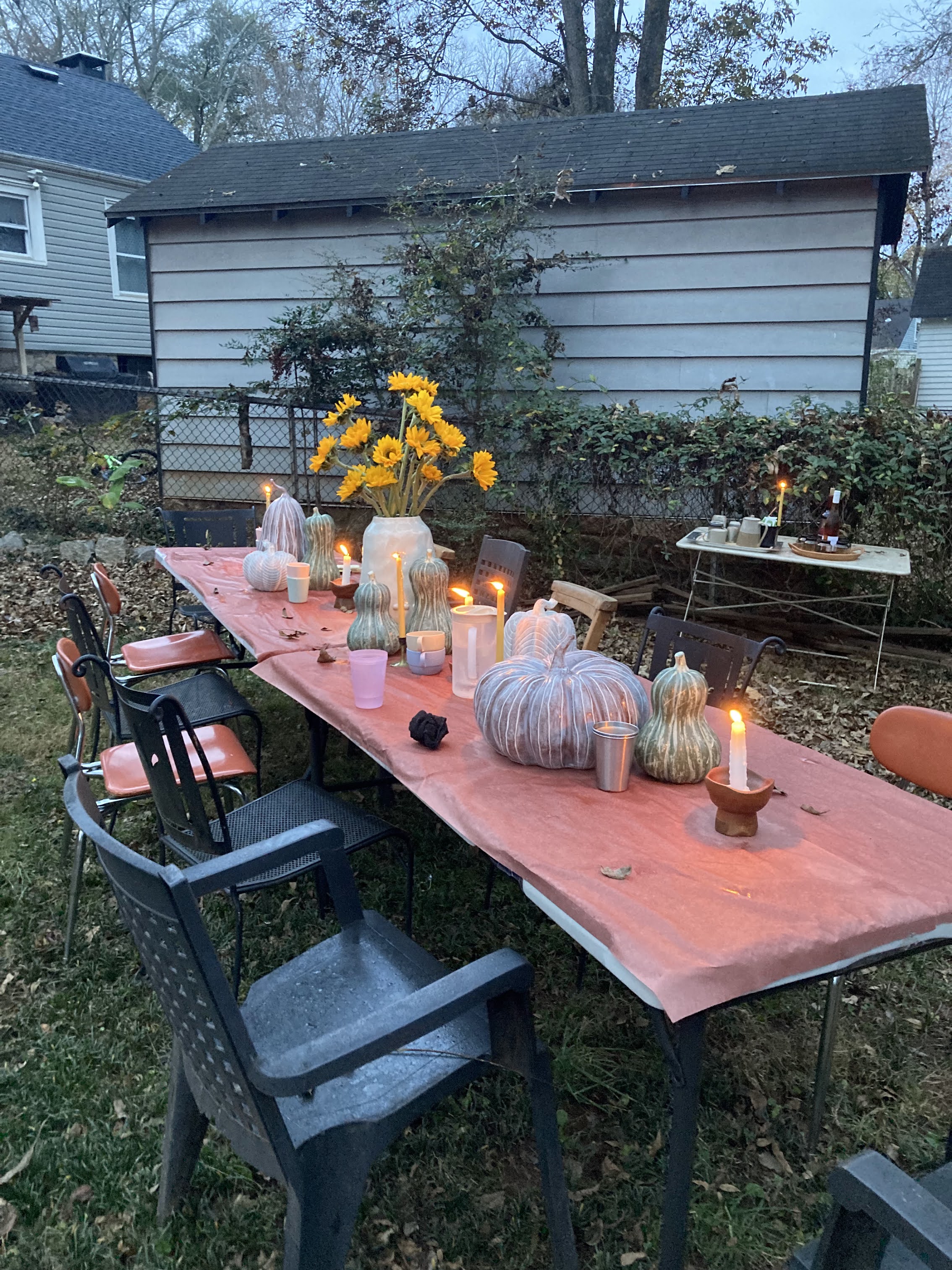
We love our little house. It is warm and safe and insulated from the harshness on the other side of the world. As we prepared our table in the rain, with borrowed decorations and mismatched chairs in candlelight, I thought of the horror lighting up backyards and neighborhoods in Gaza.
French loaves and round loaves baked while the ingredients for squash soup simmered and adjusted to my seasoning whims. I threw ice cubes in the oven, my made-up hack for a water bath, and prayed my haphazard disregard for timing and instructions would still produce something edible. I tripped over the 1 year old and had words with the 8 year old who insisted every art supply was needed for the gifts she was preparing for our guests. The 6 and almost 4 year old were, as per uzh, completely oblivious to the fact of hosting at all. Although, they managed to pop up every 17 minutes to ask, “When is the party starting again?”
The habit of hosting is spiritual warfare. It is perceiving books pushed off the shelves in the movie Interstellar to reveal an entirely different dimension, a time and space of different rules and a kingdom where the right rule is perfectly reflected. Heaven. The picture of God as Host is perhaps my most intimate understanding of my Maker. It’s about the inviting, the preparing, the knowing, the making space… and all of it for the purpose of existing in the same room, in the same moment. That is the reward. That is the joy of the Maker, the delight of the Father. To be with me. To be with us.
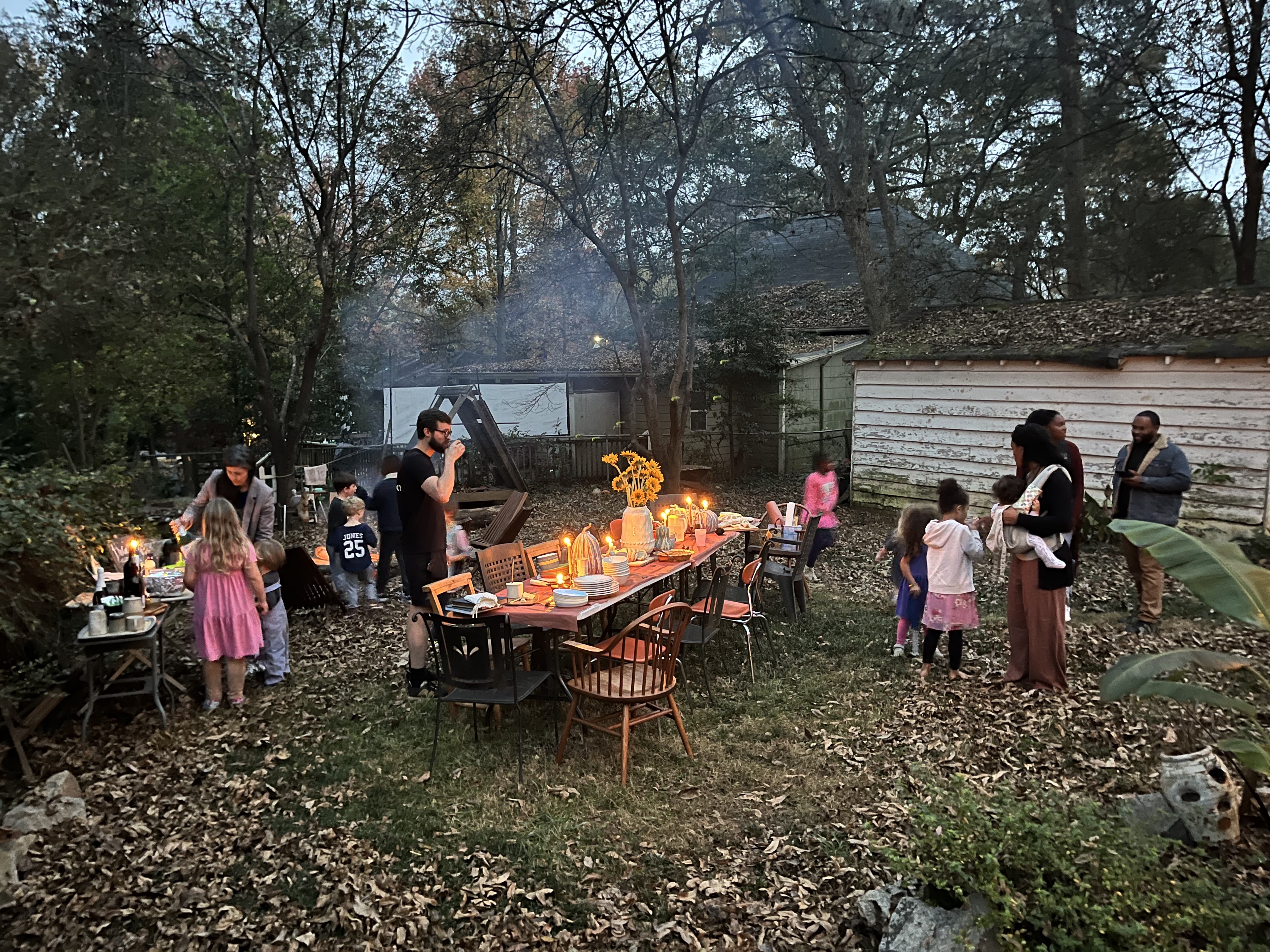
Sometimes, in my immaturity, I wonder if I host to better know this truth– to heal the unbelief that He hasn’t actually invited me or won’t actually follow through with the plans for the feast in the land of Zion. There’s always a moment, pre-party, where I wish we get rained out– or that some external factor would relieve the stress and failure of the hosting mayhem. But, then the mist clears, the crowd comes, and the imperfect party feels like the kingdom of heaven. Surprise guests arrive. Kids spill the “kid wine” and refuse indulgent mashed potatoes. The candles are perfect for 15 minutes at dusk and then nearly light hairs on fire before burning down past the candle holder and providing less than ideal light. The night hides the outdoor tables and crunchy pecan leaves land in the potato salad. And it feels like the kingdom.
The habit of hosting is spiritual warfare, but what a miracle of a reality that, if we invite Him, the King of heaven and earth and all creation shows up in all His glory to proclaim the battle is won. Hosting is acting out the belief that the King of heaven has held nothing back in His invitation and as we reflect that likeness, neither should we. It is a battle cry that doesn’t reverberate or echo in the hollow chambers of the interwebs but comes alive inside the hearts of those present.
It got loud, there were tumbles and offenses and hurt feelings and demands for more pumpkin mousse. But, in the middle of it, we made sure to name where we were directing our thanks. We prayed a prayer as we broke the bread that the delight in our tasting of it would pale in comparison to our delight in the sharing of the Bread of Life. We prayed again as we built little ebenezers as a family to remember the way the Lord had been faithful in the past year. The Lord be praised, for He has shown up!
The habit of meeting together is a spiritual act of resistance! We proclaim the Lord’s name as we crucify our desire for perfect behaviors and pinterest tablescapes. We proclaim the Lord’s name as we lift up the sounds of a rowdy game of tag or a very involved play daycare situation that has developed on the deck. We proclaim the Lord’s name as we invite in new friends and friends of those friends. The Lord, the Lion and the lamb, is on the move. There is something about gathering together that reminds us that this spiritual battle is not a local one. The habit of meeting together is also the habit of mobilizing, training, and joining the global resistance led by the servant king of heaven. The boot camp is the kitchen and the art studio and the garden and the tool shed and the writing workshop.
Our habit of meeting in the glow of our little house is a direct response to the horrors happening in the dark world because the kingdom of God is not a local kingdom– not a national kingdom, not a government or a movement. The kingdom of God is a reality that we embrace as we meet together, imperfectly and wherever we are in the world, and desperately seek His face.
Come, Lord Jesus! Heal my unbelief that I’m not invited to your table even as I invite others to ours.
I forgot the tender stack of leaves in the car. We had collected them the day before in North Georgia, on a winding trail up and around rocks that eventually led to a tumbling river. Oak, maple, dogwood, sweetgum. The colors struck a rainbow of pigments that told tales of their time in the sun. They survived two brothers’ antics and the constant bend and snap of a mother noticing nature and keeping her brood safe. The stack delighted me as I added to it, showing it off to my partner and holding it up in the light.
But, I forgot the tender stack in the center console between the captain seats of our Sienna. I collected it again when I found our coffee bean bag empty the morning after we returned from our trip. The leaves had curled on themselves, the brighter ombre colors turned inward and the dull undersides showed a different kind of beauty. The stack snuggled in, hugging themselves with leaf arms and stems stretching out, in seeming futile hope of reaching the branch that once gave it life.
I love the crunchiness of this time of year. Where the ground once squished, it now crackles underneath my feet. Each leaf has its own delicate story of beginning and living and dying with the almost weightless grace. The science of leaves changing colors, from bud to broad to breaking free, is easily explained with pigments and sunlight– my daughter tells me, anyway. But the enduring truth of the whole process speaks of something less calculated.
When God began things– breathed or spoke or willed or wooshed the world into being– He immediately constrained things to time, ordering the days, weeks, years and seasons in a way that could tell an ordered story back to the creation seeking Him out. And the story these leaves tell (or, maybe one of the many stories), is one of life and death and community.
I’ve always wondered at the beauty of the death in the seasons. We gaze in awe at the colors as they change, travel long distances to stare at mountainsides and clamor up trails where the trees are tight together. We are shocked every year that the leaves have done it again, though we know exactly why and how. We pull the autumn season up around our ears like a blanket and sit to watch the firework display that cannot be replicated or outdone by human hands. This is the work of the Creator. So, why must this mastery disappear? Why must the leaves leave?
I look at the curled clump of leaves now brittle in my hands. I notice the dry cracks around my knuckles and remember winter will morph my body as well. We will collect leaves and string them up in our living room soon, hanging them so the tallest heads have to duck underneath. We will notice the way each leaf is different in color and pattern and the ways they dance when the boys wrestle the walls.
But, these brittle leaves in my dry, autumn hands are not stretched out like nature’s bunting above our heads in the living room. These leaves I stacked so carefully are now curled in snugly and I read my own story back from them– that when my life began by the thought or the song or the woosh of my Creator, my life was also starting to die. My fate as a daughter of Eve and Adam is that my current body is not my forever vessel.
We are, those of us with breath, leaving this place even as we are living in it.
And though my body’s clock began a countdown when it breathed first, I remember God did not think it good for Adam to be alone. When sin broke the lifeblood and beauty of their garden home, they needed each other. They curled in even as they were cast out and God knew. God provided community before the first sadness had ever snuck in with sin. God knew that the bodies he formed from dust would be brittle in a different way, breaking with the weight of a free will that chose to defy the living God in violent acts of self glory.
The story of these curling leaves is the story of my own heart– hurt by my own sin and the weight of a world filled with brokenness. As I reach out to live out my days in all their glorious pigments and seasons, I curl in with a body that cannot be alone. And this is the Lord’s good provision inside the fate of our leaving.
It started because we wanted to see and feel Easter – to shake off everything regular for our greatest festival celebration. So, we literally put on our party, looking like a wedding where everyone is the bride. And then somehow it stretched into the whole Easter season… my high kick to winter and death and the muted colors of typical Brooklyn fibers.
Yesterday, I folded into a wooden pew next to Patrick after I successfully passed Z Ru off to the nursery magicians. I followed the stitching on the white that hung just over my wrists as Vito talked about the deep sadness of joy – the weeping and the wearing and the working of it.
Jesus preached that there is blessing – there is joy – absolutely inside the worst things. Yes, absolutely. Because Jesus is inside the worst of things, just exactly where you think He is not. He is behind and in between and above the worst, saying, “Come, heal, breathe, hear, repent, believe, stay, rest…”
And that’s hard. I disbelieve that for joy, I think.
I already confessed my light Lent, but I forgot to say that there is something else I feel – something other than regret. The world is brimming with weeping and wearing and working, in bad ways. The worst. I am not strong enough to even hear all of it. I don’t know what to do with the headlines and the histories and personal hells typed out in simple texts. Because I am afraid I can do nothing, afraid what I can do is not enough.
My grief weight is heavy. Just the weight of my sorrow could sink a ship, I am sure of it. But there are entire cities, countries, and continents filled with people who bear the same weight.
The sheerness of my white sleeves put a fuzzy filter on my arms, a weird and welcome distraction from the message about sad joy. The points rolled out on Luke 6:20-26, just two about joy coming by way of discipling relationships and consolation.
And he lifted up his eyes on his disciples, and said:
“Blessed are you who are poor, for yours is the kingdom of God.
“Blessed are you who are hungry now, for you shall be satisfied.
“Blessed are you who weep now, for you shall laugh.
“Blessed are you when people hate you and when they exclude you and revile you and spurn your name as evil, on account of the Son of Man! Rejoice in that day, and leap for joy, for behold, your reward is great in heaven; for so their fathers did to the prophets.
“But woe to you who are rich, for you have received your consolation.
“Woe to you who are full now, for you shall be hungry.
“Woe to you who laugh now, for you shall mourn and weep.
“Woe to you, when all people speak well of you, for so their fathers did to the false prophets. (Luke 6:20-26 ESV)
I heard myself mmhmm. Jesus. I want to get in his sights. I want to be there when he lifts up his eyes because then I might feel sure about being in His presence. I know that is where joy reaches fullness, somehow.
But He pairs blessing with the absolute worst things: poverty, hunger, weeping and then being hated, excluded and reviled. How can joy get inside these things? Jesus.
Somehow, mysteriously- magically even, Christ is deeper than dark. Light came into the world and the darkness could not overcome it. I memorized that when I was nine, but I always thought it was a light like the break of day, chasing cold shadows to corners and covering like a warm blanket that keeps only good underneath. I’ve always imagined light versus dark as a cosmic battle of no contest, where the two rushed in from separate directions to make a messy collision in a long, deep valley. A crowded mess of thunderstorms and white robes and lightning and dark forces and probably Gandalf, but the sides stayed easily distinguishable – in my mind.
But this deeper-than-dark light is something new to me. If in Christ all things are held together – the aloe plant in my window, the rain drops dripping April, Zella’s squishy little body, and the superlative worst – then He is there in all these things, too.
Inside poverty and hunger and sadness – the deepest of it – Jesus is deeper still. It seems wrong to flip the superlative like that. Find the absolute worst thing, and there find the absolute best thing hiding. It doesn’t make any sense for Jesus to promise that. And then I think about the cross, the whole cruel journey of it, and the story looks different.
He was the light that couldn’t be overcome, but he was crucified. He was so, so deep in the darkest of us. He is light in the deepest, darkest of us – holding all things together, overcoming death and claiming victory over evil. Definitively. Absolutely. Making joy the surest thing because He (Jesus) is the surest thing. Surer than death, even.
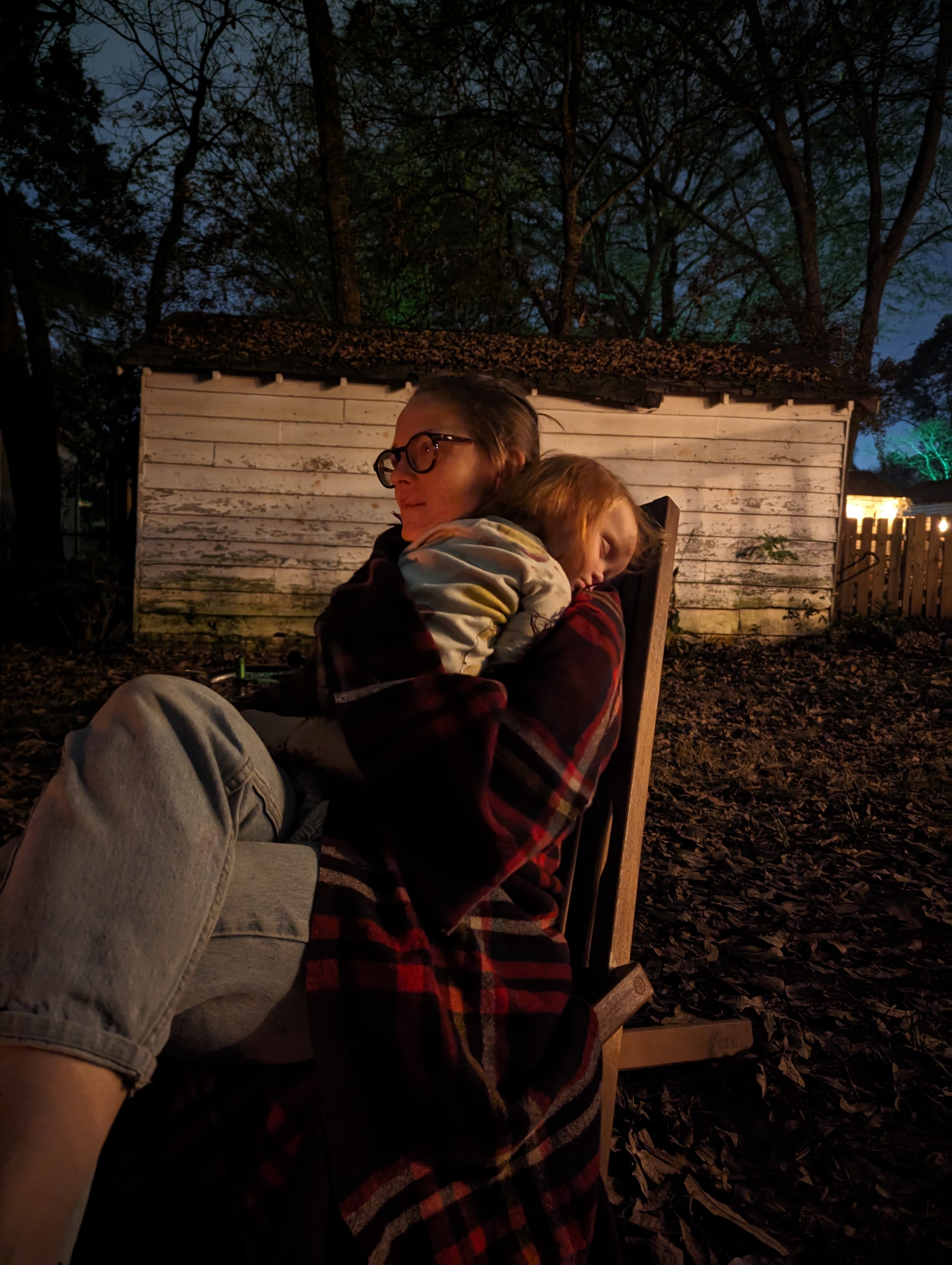
I ended up with a whole loaf of communion bread on the bus ride home from church. Zella wriggled under my chin, fighting sleep, and it felt deeply appropriate to rip off fistfuls of the sourdough and let it work my jaw. The body broken for me… the darkness lit for me… the joy assured for me.
It still doesn’t make any sense. I think the light hiding deeper than dark scene is hard to choreograph behind my eyes. The light that doesn’t come from darkness… the light that is somehow deeper than darkness and can reach all the sunken ships full of the world’s grief weight.
And in that mixed up meeting of light and dark, there is our joy called Jesus. And we are happy with Him alone.
This was the offering song Sarah Gregory sung for church yesterday and it is still sweet honey to my disbelieve-for-joy soul. She learned of the song four hours before she sung it. God is so good and full of grace for us.



 MUSINGS IN THE MIDST