when I shout my lonely office

It’s full again. I empty the Dyson and the dust puffs up in my face. I check the simmering onion and garlic with a glance, tie the red strings and lift the garbage with my good arm while I close the door under the sink with my foot. Vesper is still boundary training. I throw a towel over the naan dough and pray it’s clean enough, and then rush out the front door in sock feet to sling the bag at the bottom of the front steps. Before I bend-snap my shoulders back up above my hips, I clock the distance to the garbage can.

The red, stretched out strings find my fingers and I take the long way– sidewalk, pavers, retaining wall before slinging the bag with my bad arm, careful not to rotate it too far above my shoulder. By the time I race my socks back inside, the garlic has nearly gone but can still be saved. Praise. Curry tonight and it’s got to be a swift and substitution-heavy turn around for our meal.

My mind wanders back to Robert Hayden. Lines from the poem yesterday are alighting like the chickadee bird of our school research today. Foster tells me that chickadees are so smooth in flight you can’t hear them. I imagine a chickadee might surprise me with its presence, though if I had eyes to see or ears to hear I might have noticed its arrival.

What did I know, what did I know
of love’s austere and lonely offices?

Robert Hayden in “Those Winter Sundays”

What do I know, about serving with a heart that doesn’t keep track of the broom sweeps and the simmered garlics and the nuance of a day’s schedule. What do I know of love’s lonely office? Still little, maybe nothing.

The office I keep is haphazard and more Jekyll + Hyde vibe than I would like, than I hoped… than I claimed for my future when I was envisioning this phase. I am not what I envisioned. I’ll say that, for sure. I’m far worse. Where has all the wisdom gone? That’s what I asked of Solomon over peppermint tea at Kiara’s house as we studied prophets in the Old Testament and somehow landed on Solomon’s backsliding. The man literally asked God for wisdom and was granted it and STILL he ended up with 700 wives and who knows what else in his disobedience. What we do know is the little letters in the text cannot contain the havoc his sin wreaked. Somehow, he got less wise as he got older! I sipped my tea and passed judgment and then listened as my sisters shared that shrinking in wisdom was a bit of an epidemic.

We’re into our morning now, breakfast and reading aloud and prayers. I committed to ignore my phone until scripture finds my face in the morning, so the world could be ending and I am blissfully unaware for the next 17 minutes. We’re out of order, but we’re in the first week of advent school, so everything feels a bit disjointed. I come to our Scripture this week and we read from Isaiah 11.

I thought it would be a few verses, but as I am reading I become animated. I lean dramatic, so a prophetic passage can’t be appropriately delivered sitting down. “Righteousness will be the belt of his waist!” I proclaim as I motion for a giant belt securing my middle. “And faithfulness the belt of his loins!” I know less where to motion for this but I am dramatic, still. The whole passage comes alive in front of me– the impossibility of a Savior, the unlikelihood of people being around to even be looking for one. And yet the prophet paints the picture.

These are the words that had to be repeated, from generation to generation to generation to generation. Words guarded and savored like secret recipes passed down with a knowledge of their potency, their flavor and power. These words of the prophets were the words for all the years of silence, when the mornings and the noondays and the evenings seemed only dark. When the ordinary going out and coming in required belief in a faithful God who had spoken promises, but had stopped speaking.

Can you believe this? 700 years before Jesus came and THESE words were given to the prophet Isaiah? Wow, but do you see? I am jumping now and they are laughing. Praise God for laughter as it shakes off offenses of spilled milk and withheld apologies. These words about who? “Jesus,” they say. Yes! And when Jesus came did all the dark go away?

At this, they are not quite sure. It feels like the pep rally answer is YES but that somehow doesn’t feel true. That’s what I’m sensing in their faces at least. I get a mumbled majority, “No?” like a question. That’s right! When Jesus came into our darkness, fulfilling this prophecy, the darkness did not go away. But, he did give us a way out. He did open a door so we didn’t have to stay in this darkness forever.

And I felt alive in a new way. A mess of wires behind my ribs connected again and I felt the power of hope. Hope? What an impossible thing to hold.

There shall come forth a shoot from the stump of Jesse,
    and a branch from his roots shall bear fruit.
And the Spirit of the Lord shall rest upon him,
    the Spirit of wisdom and understanding,
    the Spirit of counsel and might,
    the Spirit of knowledge and the fear of the Lord.
And his delight shall be in the fear of the Lord.
He shall not judge by what his eyes see,
    or decide disputes by what his ears hear,
but with righteousness he shall judge the poor,
    and decide with equity for the meek of the earth;
and he shall strike the earth with the rod of his mouth,
    and with the breath of his lips he shall kill the wicked.
Righteousness shall be the belt of his waist,
    and faithfulness the belt of his loins.

Isaiah 11:1-5

This is the righteousness that will expose the wars within and without of my bones. My lack of love in my lonely office and the languishing faces of those despairing. This Jesus, the door out of the darkness, invites me come and walk with him. And I review my steps. Simmering garlic, running sock feet errands, reciting prophetic words, alone and lonely in a house full of disciples. The thoughts all tumble back down in the mental jenga game as Pat gets home from work and we sit down to pray over our curry while I take the naan out the oven foolishly with my fingers.

Something about conviction that I need to be seen and noticed and it’s not enough that God knows. I’ll return to it tonight, maybe tomorrow? I know it is an important thought about the poem, but now there is a basketball game for our dear Miles. Sweep the rice, clean the plates, sock the kids, and make a sign that says, “Go Miles!”

What do I know? It’s advent and the darkness is not hiding.

Leaving

I forgot the tender stack of leaves in the car. We had collected them the day before in North Georgia, on a winding trail up and around rocks that eventually led to a tumbling river. Oak, maple, dogwood, sweetgum. The colors struck a rainbow of pigments that told tales of their time in the sun. They survived two brothers’ antics and the constant bend and snap of a mother noticing nature and keeping her brood safe. The stack delighted me as I added to it, showing it off to my partner and holding it up in the light.

But, I forgot the tender stack in the center console between the captain seats of our Sienna. I collected it again when I found our coffee bean bag empty the morning after we returned from our trip. The leaves had curled on themselves, the brighter ombre colors turned inward and the dull undersides showed a different kind of beauty. The stack snuggled in, hugging themselves with leaf arms and stems stretching out, in seeming futile hope of reaching the branch that once gave it life.

I love the crunchiness of this time of year. Where the ground once squished, it now crackles underneath my feet. Each leaf has its own delicate story of beginning and living and dying with the almost weightless grace. The science of leaves changing colors, from bud to broad to breaking free, is easily explained with pigments and sunlight– my daughter tells me, anyway. But the enduring truth of the whole process speaks of something less calculated.

When God began things– breathed or spoke or willed or wooshed the world into being– He immediately constrained things to time, ordering the days, weeks, years and seasons in a way that could tell an ordered story back to the creation seeking Him out. And the story these leaves tell (or, maybe one of the many stories), is one of life and death and community.

I’ve always wondered at the beauty of the death in the seasons. We gaze in awe at the colors as they change, travel long distances to stare at mountainsides and clamor up trails where the trees are tight together. We are shocked every year that the leaves have done it again, though we know exactly why and how. We pull the autumn season up around our ears like a blanket and sit to watch the firework display that cannot be replicated or outdone by human hands. This is the work of the Creator. So, why must this mastery disappear? Why must the leaves leave?

I look at the curled clump of leaves now brittle in my hands. I notice the dry cracks around my knuckles and remember winter will morph my body as well. We will collect leaves and string them up in our living room soon, hanging them so the tallest heads have to duck underneath. We will notice the way each leaf is different in color and pattern and the ways they dance when the boys wrestle the walls.

But, these brittle leaves in my dry, autumn hands are not stretched out like nature’s bunting above our heads in the living room. These leaves I stacked so carefully are now curled in snugly and I read my own story back from them– that when my life began by the thought or the song or the woosh of my Creator, my life was also starting to die. My fate as a daughter of Eve and Adam is that my current body is not my forever vessel.

We are, those of us with breath, leaving this place even as we are living in it.

And though my body’s clock began a countdown when it breathed first, I remember God did not think it good for Adam to be alone. When sin broke the lifeblood and beauty of their garden home, they needed each other. They curled in even as they were cast out and God knew. God provided community before the first sadness had ever snuck in with sin. God knew that the bodies he formed from dust would be brittle in a different way, breaking with the weight of a free will that chose to defy the living God in violent acts of self glory.

The story of these curling leaves is the story of my own heart– hurt by my own sin and the weight of a world filled with brokenness. As I reach out to live out my days in all their glorious pigments and seasons, I curl in with a body that cannot be alone. And this is the Lord’s good provision inside the fate of our leaving.

I want to get in His sights

I am wearing white for Eastertide.

It started because we wanted to see and feel Easter – to shake off everything regular for our greatest festival celebration. So, we literally put on our party, looking like a wedding where everyone is the bride. And then somehow it stretched into the whole Easter season… my high kick to winter and death and the muted colors of typical Brooklyn fibers.

Yesterday, I folded into a wooden pew next to Patrick after I successfully passed Z Ru off to the nursery magicians. I followed the stitching on the white that hung just over my wrists as Vito talked about the deep sadness of joy – the weeping and the wearing and the working of it.

Jesus preached that there is blessing – there is joy – absolutely inside the worst things. Yes, absolutely. Because Jesus is inside the worst of things, just exactly where you think He is not. He is behind and in between and above the worst, saying, “Come, heal, breathe, hear, repent, believe, stay, rest…”

And that’s hard. I disbelieve that for joy, I think.

I already confessed my light Lent, but I forgot to say that there is something else I feel – something other than regret. The world is brimming with weeping and wearing and working, in bad ways. The worst. I am not strong enough to even hear all of it. I don’t know what to do with the headlines and the histories and personal hells typed out in simple texts. Because I am afraid I can do nothing, afraid what I can do is not enough.

My grief weight is heavy. Just the weight of my sorrow could sink a ship, I am sure of it. But there are entire cities, countries, and continents filled with people who bear the same weight.

The sheerness of my white sleeves put a fuzzy filter on my arms, a weird and welcome distraction from the message about sad joy. The points rolled out on Luke 6:20-26, just two about joy coming by way of discipling relationships and consolation.

And he lifted up his eyes on his disciples, and said:
“Blessed are you who are poor, for yours is the kingdom of God.
“Blessed are you who are hungry now, for you shall be satisfied.
“Blessed are you who weep now, for you shall laugh.

“Blessed are you when people hate you and when they exclude you and revile you and spurn your name as evil, on account of the Son of Man! Rejoice in that day, and leap for joy, for behold, your reward is great in heaven; for so their fathers did to the prophets.

“But woe to you who are rich, for you have received your consolation.
“Woe to you who are full now, for you shall be hungry.
“Woe to you who laugh now, for you shall mourn and weep.
“Woe to you, when all people speak well of you, for so their fathers did to the false prophets. (Luke 6:20-26 ESV)

I heard myself mmhmm. Jesus. I want to get in his sights. I want to be there when he lifts up his eyes because then I might feel sure about being in His presence. I know that is where joy reaches fullness, somehow.

But He pairs blessing with the absolute worst things: poverty, hunger, weeping and then being hated, excluded and reviled. How can joy get inside these things? Jesus.

Somehow, mysteriously- magically even, Christ is deeper than dark. Light came into the world and the darkness could not overcome it. I memorized that when I was nine, but I always thought it was a light like the break of day, chasing cold shadows to corners and covering like a warm blanket that keeps only good underneath. I’ve always imagined light versus dark as a cosmic battle of no contest, where the two rushed in from separate directions to make a messy collision in a long, deep valley. A crowded mess of thunderstorms and white robes and lightning and dark forces and probably Gandalf, but the sides stayed easily distinguishable – in my mind.

But this deeper-than-dark light is something new to me. If in Christ all things are held together – the aloe plant in my window, the rain drops dripping April, Zella’s squishy little body, and the superlative worst – then He is there in all these things, too.

Inside poverty and hunger and sadness – the deepest of it – Jesus is deeper still. It seems wrong to flip the superlative like that. Find the absolute worst thing, and there find the absolute best thing hiding. It doesn’t make any sense for Jesus to promise that. And then I think about the cross, the whole cruel journey of it, and the story looks different.

He was the light that couldn’t be overcome, but he was crucified. He was so, so deep in the darkest of us. He is light in the deepest, darkest of us – holding all things together, overcoming death and claiming victory over evil. Definitively. Absolutely. Making joy the surest thing because He (Jesus) is the surest thing. Surer than death, even.

I ended up with a whole loaf of communion bread on the bus ride home from church. Zella wriggled under my chin, fighting sleep, and it felt deeply appropriate to rip off fistfuls of the sourdough and let it work my jaw. The body broken for me… the darkness lit for me… the joy assured for me.

It still doesn’t make any sense. I think the light hiding deeper than dark scene is hard to choreograph behind my eyes. The light that doesn’t come from darkness… the light that is somehow deeper than darkness and can reach all the sunken ships full of the world’s grief weight.

And in that mixed up meeting of light and dark, there is our joy called Jesus. And we are happy with Him alone.

This was the offering song Sarah Gregory sung for church yesterday and it is still sweet honey to my disbelieve-for-joy soul. She learned of the song four hours before she sung it. God is so good and full of grace for us.

celebration and sorrow

Zella Ruth knows nothing about Good Friday – that it is actually bad, dark, and terrible. She knows nothing about the repetition of “Were you there when they crucified my Lord?” and nothing about the silent exit of the night liturgical service. I’m not really doing a very good job of educating, though. I spent Holy Week singing “Glory, Glory Hallelujah” and dance-contorting all over the spring warmth in our apartment. We spread a blanket in the park and talked about blooming trees, fingered blades of green grass, and squinted up at the bright sun. We woke up extra early on Friday to go to the flower district in Manhattan for Sunday’s centerpieces. ZRu’s first Holy Week outside my belly was not heavy with sadness at all.

I lacked sorrow for the via dolorosa this year.

I just couldn’t manage to let death and depravity cast its shadow over those 40 days. I couldn’t get around to it. Grief wiped me out the last two years. It took all my energy and  I didn’t have time to imagine plumbing those depths again.

After the dust settled on Christmas and Epiphany, my heart got good and fixed on the resurrection. No, this year was not the time to teach Zella about Lent sadness, not with words anyway. Maybe she felt the water dripping off my eyes… or a different rhythm as she pressed up against my chest… or a restlessness in my preparations as I wore her tight under my chin.

It’s all tangled up, this celebration and this sadness, in confetti tears and Google spreadsheets and clean sheets and a bit of silence that comes as a surprise on a Thursday before the mushroom red sauce is served over quinoa.

I am not making any progress and I suppose that is still grace.

There was a moment at our Easter celebration, one of those I just curled up into. Can you sit on the lap of a moment, can it stroke your hair and say, “You will be okay.” Can a moment do that?

12909694_647173178961_7941328781220480517_o

In some ways, Easter was everything my heart was hoping for because it has to be. It is the easiest party to plan because there is victory already inside it – the biggest and most victorious victory that heaven declares with celestial confetti and hell recognizes like yesterday’s news. Because it is. It already happened.

So, I’m not surprised my heart swelled to sing liturgy, to stand with the choir, to sway with sweet Zella on my hip, to take the bread and the cup, and to hear the words proclaiming our greatest festival.

But there’s something you may not know or assume about me, when it comes to parties. I get so worked up – so blind with starry eyes about the beauty of it that I almost make myself sick. I had imagined this crazy build up for the moment we honored the Host of our gathering, but I got caught tongue tied and fumbled all over the raised glass I was pretending to hold. I had misplaced the confetti and the champagne was only partially poured when I called for the big hoo-rah!

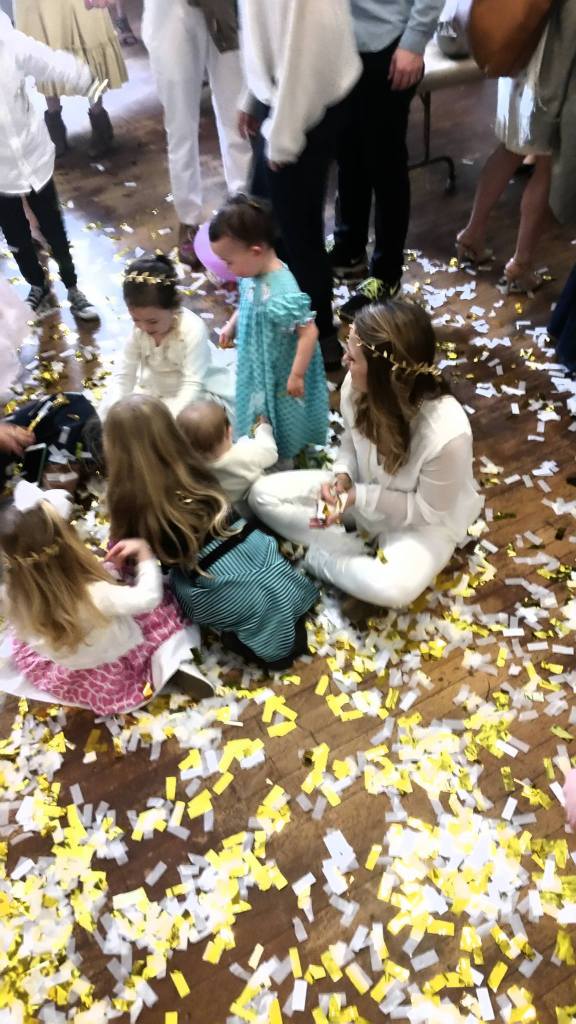
But then, this moment happened and I melted into it – right onto the floor where I found my people. These sweet, bright souls who knew exactly what to do when confetti appeared.

Looking back, I might have spent too much of the liturgy of that day wishing I had Lent-ed harder or planned better. But, somewhere inside that moment, I was learning from Senna and William and Ezra and Orion and Hannah and Zella – all the littles who knew just what to do with paper celebration.

We got lost in it. I’m not sure how long I sat there in my white pants, letting gold and white confetti rain down from the sky from sweaty little fingers rushing to throw it up in the air. The moment, God, held me with a tender knowing.

My inner eight-year-old followed celebration and found sorrow. I gave in to wild delight inside that confetti moment, but there was – creeping in the cracks of that fellowship hall – a stretch of sorrow.

Like light streaming in, sorrow pulled at my eyelids and scratched across my throat. Already and not yet, they say. Christ has conquered the grave and offered that victory to us, but we are awaiting his return. We are looking forward to final peace.

And I am having trouble with the tension.

I can’t put words to it because they seem at once too harsh and too soft. I am the disciples on the way to Damascus. I am disbelieving for joy. I am in the middle of a spirited hoo-rah, summoning energy from a force outside me to throw joy into the air when I become very aware of corners and shadows and my brother’s ashes somewhere in an urn on a shelf.

I am disbelieving for joy that God has won, that He wins in the end. Somehow, I can’t formulate the cardboard book version of this tale, not now anyway.

Until then, Eastertide – this season to celebrate freedom and life and secure hope. And mushroom red sauce with quinoa.


all this tomfoolery

“Gardiner and Theobald.”
“Yes, hello, may I speak to Mary Smith please?”

“Sure! May I tell her who is calling?”
“Yes, it’s John Doe. How are you doing today?”

“Oh, I’m doing fine. How are you? Let me see if I can reach her for you.”
“That would be so great. Thank you so much.”

“John, I’m not able to reach her at her desk, would you like her voicemail?”
“You know what? I’ll just send her an email. I guess I really just miss talkin’ to people, you know? Thank you so much. Have a great day!”

The conversation happened at 10:09 am and I thought about it until I left the office. I don’t know who John Doe is (and that’s obviously not his name) and I don’t know why he needed to talk to Mary Smith (also not her name) at my office and I definitely don’t know why he told me (the unnamed receptionist screening calls all day like a boss) about his desire for human connection.

I tried to answer calls a little differently the rest of the day, more like a human and less like a robot. Sure, I already have my favorites. There’s the guy who calls from NBC who has the kindest voice and the absolute best lilt to his phone pleasantries. Then there’s the guy on the 15th floor with the exaggerated English accent that rolls out into a musical melody. But, most of the calls I answer during the day make both of us sound like robots. We go through the call/response like office liturgy, an ode to the places we work in order to spend time in the places we don’t.

But, it’s kind of nice to be a robot. I mean, I can triple multi-task now – answer phones, redirect calls, create fedex shipments, all while carrying on a halting conversation with my coworker about the benefits of oregano oil. I’m not sure if I can do any of those multi-tasks super well if I do them all at once, but that’s where the robot benefits come in: things get done.

Anyway, John Doe’s phone call this morning really rattled me up. Just yesterday, I was talking to my coworker (in one of those halting conversation beneath the mounds of multi-tasks) about how incredible it is to have language – letters and words and symbols that smash together into phrases and sentences that explain the reality we walk inside everyday.

What is more incredible to me, today at least, is that we have an emotional attachment to that language. We want to speak and be understood, to listen and to comprehend. And all this tomfoolery with email and text messages and electronic robottery makes us feel like we’re missing something pretty elemental. Sure, we might lose some efficiency, but I’m not sure what we gain is “worth it” in the long run.

Maybe it is and maybe this is just another rant against technology. But I get you, John Doe. I like to hide behind typed words for efficiency’s sake and for anonymity and for the protection of it, but sometimes I just really miss talking to people.

I’m going to try to do that more, so thanks for the inspiration, caller-I-will-never-meet. I am literally off to (my friend’s) Grandmother’s house in the country tonight, where the old-fashioned kind of communication is going to make a lot of sense. Maybe I’ll pick up a few pointers the city has forgotten.

the sun will rise

Love as Christ loved.

That is the message of Maundy Thursday, the new commandment Christ gave to the disciples in his final, informal sermon. Love one another. He commands it because He knows it can be done, though it is impossible.

We are not naturally lovely people – not naturally kind or caring. We are selfish and proud and have been since that forbidden fruit. We guard our independence and vacation time and personal freedom and charity, considering others sparingly and only when we feel like it. To “love one another” is an impossible command, but Jesus commands it because He knows it is possible. His is a love that can swallow up every force that opposes it, even death.

His is a love that empowers love when the network of human nature fights against it.

Christ shows us love and then commands us to do what only He can make possible in our lives. “Love one another” is not a reason for Easter resolutions or a slogan for social justice. “Love one another” is an impossible command that Jesus obeyed perfectly on the cross, a command that we can obey by way of His righteousness.

Jesus commands us to love one another and then He shows us what love looks like as he lives out the prophecy spoken in Isaiah.

Who has believed what he has heard from us? And to whom has the arm of the Lord been revealed? For he grew up before him like a young plant, and like a root out of dry ground; he had no form or majesty that we should look at him, and no beauty that we should desire him. He was despised and rejected by men; a man of sorrows, and acquainted with grief; and as one from whom men hide their faces he was despised, and we esteemed him not. Surely he has borne our griefs and carried our sorrows; yet we esteemed him stricken, smitten by God, and afflicted. But he was pierced for our transgressions; he was crushed for our iniquities; upon him was the chastisement that brought us peace, and with his wounds we are healed. All we like sheep have gone astray; we have turned—every one—to his own way; and the Lord has laid on him the iniquity of us all.
[ISAIAH 53:1-6]

I still do not understand it, but I read myself in these words. I hid my face, esteemed him not, and threw my grief on his bloody back. And today we remember that He was crushed. He was pierced and wounded because of our black hearts and secret sins. Today, we remember the sky went black when death killed the healer.

This is the darkest day, but there is hope on the horizon. There are rays hiding behind the dark sky, lit by the glory of the Creator – our God who knew all along that there would be a resurrection. And the resurrection lights the way for our love of one another.

hot pressure heartburn

It felt like heartburn, but I am sure it wasn’t.

The hot pressure pushing against my rib cage on Monday might be as close as I have ever felt to groaning with creation for the coming of the Lord (Romans 8:19). My body craves Jesus’ return as much as my spirit, and together (I think) they press up against my bones to remind me of my true home.

This week is about death.

Even in the triumphal entry on Sunday, we know it is death toward which we process. Even as we sing “Hosanna!” on the road into Jerusalem with the redeemed, we save our breath for the “Crucify!” in the center of the city with the masses. The true drama of the scene churns up this hot pressure heartburn behind my rib cage.

It is frightening, unless you believe in the God who keeps promises. This God, who loved the world so much that He threw His seed to the earth to be sown in death. The evidence is in the palms of His hands and the scars on His sides.

The resurrection is waiting on the other side like the buds breaking through dead branches and the sprouts peeking out from dry ground. Resurrection is hiding, buried safe in God’s plan for redemption.

This week is about death, but it was always about life to God.

“See what kind of love the Father has given to us, that we should be called  children of God; and so we are. In this the love of God was made manifest  among us, that God sent his only Son into the world, so that we might live  through him. In this is love, not that we have loved God but that he loved us  and sent his Son to be the propitiation for our sins” (1 John 3:1, 4:9-10).

“For while we were still weak, at the right time Christ died for the ungodly. For  one will scarcely die for a righteous person – though perhaps for a good person  one would dare even to die – but God shows his love for us in that while we  were still sinners, Christ died for us” (Romans 5:6-8).

“Who shall separate us from the love of Christ? Shall tribulation, or distress, or persecution, or famine, or nakedness, or danger, or sword? As it is written, ‘For your sake we are being killed all the day long; we are regarded as sheep to be  slaughtered.’ No, in all these things we are more than conquerors through him who loved us. For I am sure that neither death nor life, nor angels nor rulers, nor things present nor things to come, nor powers, nor height nor depth, nor anything else in all creation, will be able to separate us from the love of God in Christ Jesus our Lord” (Romans 8:35-39).

Passages from the Journey to the Cross devotional.

all the rightness I am not

The ash on his thumb was black and wet and when he rubbed it across my forehead I really did feel like I came from dust. The priest’s words, “From dust you came and from dust you shall return” felt like a confirmation of something I try to forget on the regular.

I was working late Ash Wednesday night, so I went with a coworker to the noon service at the local Catholic church. She knew all the right hand motions, so I just followed close behind. No one seemed to think it was weird to have a blonde-haired, non-Catholic stranger visiting their bilingual service.

And so the Lent season began.
Now, here we are in the middle and I am tempted to rush these 40 days.

If I am honest, I feel ripe for a celebration and that doesn’t fit with this somber, Lenten attitude. I crammed introspection into commutes leading up to Wednesday because I didn’t want to be hasty or thoughtless about this season. I fought for brain space between subway rappers and social media distractions because I wanted to be the right kind of prepared.

I don’t know if I accomplished all the necessary Lent preparations. I had some conversations, made some pancakes, heard some sermons, and sang some songs. But then that priest told me I was dust and I knew he was right.

And I knew I could never be the right kind of prepared, at least I don’t think so. God is just calling me to say “Yes” to all His rightness. My heart looks like my apartment right now – boxes and disorder and confusion – but I don’t need to get right in these 40 days or in preparation for them.

I need to believe Christ is all the rightness I am not.

I need to follow Christ into the desert, to fast from distractions and feast on the Word, because He is all the rightness I am not. He is all the order I cannot muster and all the beauty I cannot duplicate.

I was truly unprepared in every way for these Lent feelings. I am the wet, black ash smeared across my forehead and there is nothing I can do to get more right. But God, in His grace is all the rightness I am not. He makes a way for me to feast as I fast. He makes a way for the lowly and the weak to praise His name.

Whoa. whoa. whoa.

I can stretch into that kind of praise, with a heart that looks like a hurricane and a house that looks haphazard. I can sing this song with a full heart and know that the God who formed me from dust hears my humble song!

and the sun plays on my knuckles

I purposefully unplanned this day so I could enjoy the sunlight crawling up the windows and an entire New Yorker article in one sitting, accompanied by the lazy folk sounds of Wild Child.

Six pages is a lot to read in one sitting, maybe too much, but not when it’s in The New Yorker and not when it is written by a witty, thoughtful ninety-three-year-old man. I hope I bump into him, but I am afraid we run in different circles and Central Park is not the most convenient place for me to hang out in the afternoon. Maybe I’ll write him anyway because, who knows?

I am one of those people who tries to boast an “old soul,” so maybe we would get along just fine. I could sit for hours and listen to his tales. I once wrote several stories for a local paper about an assisted living home. I sat down with real people who had lived real, lengthy lives and just listened. It was definitely my favorite work in “advertising,” because it didn’t feel like I was trying to convince anyone to buy anything. It felt like I was having coffee with Glenda and Bob and Ruth, because that’s what I did.

The sun is making it almost impossible to see my computer screen now, but I refuse to move from my spot by the window. The golden glow on my little clicking fingers is too wonderful a feeling to abandon quickly.

Sooner or later, I will crawl out from under this purple flowered afghan my Gram gave me because I have plans to meet a friend for coffee. I will face ordinary things like watering apartment plants and attempting laundry and cleaning a manageable corner of this living space. Sooner or later and in a few minutes, I will pull away from the screen and just sit a bit before this whole glorious Monday slips away in underwhelming presidential celebration.

But I’ll first let the sun play on my knuckles a little, teeny bit longer because I imagine these are the moments Roger Angell would tell me to appreciate.

solitude is an OK thing to need

The Atlantic did not have to be the one to tell me.

I did not, necessarily, need to read it from the pen of artists who have already ‘made it,’ but I suppose I believed it more easily. I was quick to let the words resonate – to make my solitude-seeking legitimate and unselfish and regular. Maybe it was just that title, “What Great Artists Need: Solitude” that made me first click through to the lengthy article. I want to be a great artist someday (everyday) and I will gladly take all pieces of free, expert advice.

And so Dorthe Nors tells me she learned about needing solitude from the creative genius of Swedish film director Ingmar Bergman. In addition to having a very interesting name, Bergman is known for directing somewhere around sixty films and documentaries. But Nors points to his writing in The Atlantic article.

All of it resonated, but some little bits are still haunting me almost two weeks later. Because I do battle with solitude. Every time I plan a party or agree to a coffee date there are moments (and sometimes many) when I want to cancel. I want to turn inside myself because it is easier and because I’m out of energy and because there is no way I can attempt all the creative things on my to-do list if I am never alone. Let’s be honest – forget creative… I won’t get to the practical things either like cleaning out the fridge or fixing our bathroom door so it closes or worrying about the baby mouse I have seen scurry across our kitchen floor twice.

Alone time is good to get things like your kitchen and your bathroom and your soul in order. Solitude should not always get the leftovers because many times it is where we do serious business with the demons in our lives. Nors writes,

“Solitude, I think, heightens artistic receptivity in a way that can be challenging and painful. When you sit there, alone and working, you get thrown back on yourself. Your life and your emotions, what you think and what you feel, are constantly being thrown back on you. And then the “too much humanity” feeling is even stronger: you can’t run away from yourself. You can’t run away from your emotions and your memory and the material you’re working on. Artistic solitude is a decision to turn and face these feelings, to sit with them for long periods of time.

It takes the courage to be there. You run into your own pettiness. Your own cowardice. You run into all kinds of ugly sides of yourself. But the things that you’ve experienced in your life become the writing that you do. And there’s no easy way to get to it, if you want to write literary fiction.

And that’s what Bergman and other Swedish writers have taught me—to stay in that painful zone, discipline myself through it to get where I want.”

This is what Swedish authors are teaching Nors and what Nors is teaching me. It does take courage to be alone – and not just for the baby mouse that needs to be caught in my kitchen. I am a petty person and cowardly and all kinds of ugly. If I’m never alone, I never really feel the weight of those things I am. Nors talks about something Bergman wrote in one of his journals, compiled in a book called Images,

“Here, in my solitude, I have the feeling that I contain too much humanity.”

It’s not even about creating the kind of literary fiction that will be remembered like Bergman and Nors. It’s about having the imprint of eternity on our souls… and knowing that the eternal imprint is never contained by a body or inside a day.

It’s a too much feeling that not all the words in all the world could explain. But it is a tension that doesn’t need explanation as much as it needs space.

Rest. Tension. Time. Space. Struggle.

All this, my solitude-seeking, could also be related to my search for Sabbath rest. Artist or not, we all need that.

It was a jumble of reasons that landed me in the middle of reflections on solitude and Sabbath as I read the lessons Dorthe Nors learned from Ingmar Bergman. But, I guess I get it. It is good to be with people, but it is good to be alone – to fight against the too much pushing free of my chest. It is good to do battle with the space between my silent face and an empty ceiling. It is good to sit with the painful, weighty bits of humanity inside that remind me I am weak and poor and ill-equipped for everything I try.

It is good to make space enough for a full swing of the only sword fashioned to win against such a mighty weight, such a mighty too much.