grace and grief

I found myself outside early and the cool of the morning rushed over my bare legs. I welcomed the goosebumps and the good feel of a sweater hugging my shoulders. The morning chorus caused my limbs to laze, tucked into that cozy angle of our little outdoor chairs and my grandma’s afghan. My fingers found the holes, like always, curling around the knots and clinging to the wide, soft stitches. I breathed in the cool, deeply, as if I was getting ready to sing. But, I let the morning sing a solo while I listened.

This song is the song of these late summer mornings outside. Not because it plays audibly or even in my head, but just because it is what I’m doing. Meeting with. Pausing. Listening. Questioning. Slowing Down. Being with Jesus. Early is the only space and time that makes sense right now. And the song is one I hear in the birds and the breeze and the distant Marta train. The sway of the leaf dropping trees and sometimes the traffic on Sylvan Road.

I looked out on our little, sleepy street and took note of the days it had been since I had seen someone working on Tameka’s house. And right next to it, Noor’s house stared at me with two dark hollows upstairs where windows should be. Two renovations-in-progress that both feel a little bit like our street is pregnant. We are waiting and hoping and expecting the spaces to fill with life, but they haven’t yet.

I sat in my quiet perch and noticed the pile of chair and bed and dresser emerge from the morning haze as a strange monument to our neighbor’s transition. Mr. Banks passed. His step-daughter found us as we were heading out to the library the morning it happened. She crossed the street to meet me at our front yard’s edge to tell us the news. Her body was a mix of exhaustion and sorrow-slumped shoulders… that posture that almost always accompanies grief. Our bodies do know, the very nerve endings feel it. I just read an article that quoted a scientist saying something like grief is our brains trying to use the maps inside our hearts but finding them wrong and wanting. That feels accurate.

My mind drifted to the grief on the pages of another novel I’m in the middle of, Homeward. It’s set in 1962 and, in a scene I read late at night this week, Rose received news her husband was killed in active duty. Not long after, she went into labor and delivered her baby girl stillborn. The scenes following are familiar, even though I never birthed a baby stillborn or navigated the 1960s as a Black woman whose husband went off to war. Grief is not partial.

“And before I knew it, I was making sounds I had never heard come out of me before. … Nobody tried to tell me to stop. They just let me cry. … It was like birthing a baby all over again, but this time, the baby was grief, and they were my midwives. They weren’t here to stop my pain; they were here to bear witness to it.” ( p. 98, Homeward by Angela Jackson-Brown).

I remember when my greatest grief got born in our little Brooklyn apartment, the two of us huddled around a cell phone with the late summer light streaming in at a slant from the south windows. Grief is not partial, but we are not naturally trained grief midwives. Grief is everywhere, but we seem to run from it and all its graves– quick to have some other place to be or more important things to do. The women tending to Rose and Pat tending to me were very different scenes, but one similarity emerges.

And it emerged in the pages of yet another book this week, The Tales of Hibaria. This fantastical book of short stories is all situated around a boy who has been collecting these tales as they have been told to him from around the islands of Hibaria. This particular story was about a boy, Hart, whose entire family and village and every single soul he knew was wiped out by a disease brought to their island from a trader. Hart left his house and climbed into a boat and set off down a river that cut through a tall, tall forest (where no one really ever came back from). He’s by himself in this boat, finally letting all the grief have its way when a badger appears and climbs in beside him. The scene that unfolds cut my heart open.

Presently, Hart said, this time without bitterness, “What do you know of grief?”

For a long time, the badger did not reply. Then it said, “That it is a deep wound. That it feels as though it will never go away. That it feels as though it will never heal.”

“That is not very comforting,” said the boy.

“Perhaps. But that is what you are feeling, is it not?”

Hart nodded.

The badger reached down and picked up a pair of broken lanterns that lay in a tangle of rope in the bottom of the boat. The creature hung one from the sternpost behind them and then made its way to the bow and hung the other from the stempost. As the badger returned to sit beside Hart the lanterns suddenly flared bright.

“You feel that hope and beauty are dead, but they are not. They are only hidden from you for a time, made invisible by your grief.”

“But what do I do?” Hart had begun to cry again, the tears streaming down his cheeks.

“We sit,” said the badger gently. “And you mourn, which is no easy thing, while I help you to remember that there is light when all you see is darkness. We sit, and travel this slow river road together until we come out on the other side.” (p. 75, Tales of Hibaria)

Grief is not partial and it doesn’t just find us at death. It is change. It is being a stranger. It is watching a dream die. It is someone else’s loss. It is learning of grievous, unrepentant sin. It is paving old growth forests. Because, well, it’s all death. Or, at least, it is the reminder that before Adam and Eve ate the fruit of the tree of the knowledge of good and evil there was no word for grief. There were no lines in the DSM-V, no documentaries to tell the stories of suffering, no oral traditions to speak of the layers of pain and brokenness. We, with Adam, have chosen our destruction and we, with Adam, now have to birth or bear witness to grief in all its shapes and forms.

It’s sitting. It’s weeping. It’s being beside. It’s joining with. It’s stooping low. And I can’t help but think of the impossibility of a Creator God who did all those things. He sits in our grief boats and lays in our grief beds and walks on our grief paths. And he knows it all, deeper than any inner map we are lost inside. He feels it in His innermost and still He comes.

What an indescribable grace.

who we are and who we should be

“She can sure tell a short story!”

“She didn’t ask me to do a single thing at that party!”

“I love how nonlinear her thinking is!”

“My, she is indestructibly composed!”

I just read that last description in a novel and couldn’t stifle the laugh. Composed is not who I am and not really who I have ever been. If you walk into a party at my house, there is a good chance I’ll need your help cleaning or cutting the chicken or telling my children that playing hockey with tree sticks is probably not a good idea (you would end that like a question because of course you wouldn’t let them play stick hockey in the house with a rock for a puck while they rollerblade, but I have, indeed, done just that). All the other quotes above are just things I imagine no one has said of me, ever.

I was once so fully committed to the haphazard confetti of my personality that I dressed as a Christmas tree for a costume party and plugged myself into the wall for the whole thing. I’m a lot of years removed from that party in Tegucigalpa, Honduras, but I remember the absolute joy radiating from my face (or was that the Christmas lights around my neck?) like some people remember winning a championship. I didn’t win anything that night (not even best dressed), but I just loved being in my skin.

Now, in the year 2024, I have somehow time-traveled to my sixth grade year but with the saggy skin of a mid-lifer. I am unsure who to talk to, what to say, and how to share the little gems of myself at a reasonable rate while also making sure to stay reasonably curious about the needs and treasures of the folks around me. That last part is the 30 years since sixth grade, but it all seems to be overlapping in strange and vulnerable ways. What is it about our characters and our personalities that is meant to be sanctified and what is just who we are?

How do we come to have our preferences and habits and rhythms and weekend plans? Is it a series of events that have us arriving at an enneagram number and a different set of variables that defines our Meyers-Briggs? Or is it all the same information just organized differently? How much of who I am right now is the same as my six grade self (who wrote journal entries about the first day she wore shorts to school and the seating placement in history class and the rabbit skin that showed up in my locker as a gift from the locker next door). What of who we are is who we are meant to be?

I’m very much not sure about that. As much as I have lived and seen in the three decades since sixth grade, it seems that I (metaphorically) have spent the whole journey walking around the same tree. Every once in a while, I’ll turn and notice something in the bark and with the passion of a EUREKA! epiphany will declare the new knowledge to myself and others only to discover a journal entry or a blog post from 13 years ago that boldly declares the same truth. Things I learned in those early years of discovering God to be personal and holy and good are lessons I am waking up to these days like I’ve never heard the news before.

Can I be sanctified into indestructibly composed? I would settle for uncompromisingly gentle or abundantly kind. But, it’s just hard to know what is possible, you know?

What I do know is that the God who made me is full of grace and truth and is incredibly patient. I do know the fruit of the Spirit is love, joy, peace, patience, kindness, goodness, faithfulness, gentleness and self-control. I do know that those who abide in the vine will produce fruit. The Father gives us every opportunity through the Spirit to discover Him and, in discovering Him, our truest selves will come into view. Where I want to measure myself against others or my own ideas, God applies a measurement of the heart that might make little sense to the world. Whatever that truest self needs to shed and whatever it needs to grow by sanctification, I know the plumb line is sure, steady and stable.

I might ditch the novel. The theology of the 60s and 70s in England (as it’s portrayed in this book) really perverted the incredible early work of Augustine and Ambrose. I’m not sure I can keep everything in its tidy place anymore. The day is what late summer dreams are made of, so we will read outside and go on a neighborhood walk and eventually land at the library and Zella’s first band practice. And I will show up to all those places as my unfinished self, no matter how many eurekas I’ve had today.

Now, the task of embracing what is unfinished with humility and not shame, because God is glorified in my growing.

the grace you’ve been given

O Lord, we pray that your grace may always precede and follow after us, that we may continually be given to good works; through Jesus Christ our Lord, who lives and reigns with you and the Holy Spirit, one God, now and forever. Amen.

It’s always humbling when a children’s book speaks Truth that (ahem… pushes glasses up on nose) adult literature has progressed beyond. I’m not surprised anymore, but I’ve noticed that if I don’t keep a curious posture, I might miss it altogether and be like a lot of adults out here skipping childlikeness like it’s last week’s meatloaf.

So, I had to pause when Bayard the Truthspeaker was talking about a son who had strayed away from his father and rebelled. I even read the whole exchange twice for my kids (let me not lie, it was for me).

“Does a tall man deserve to be tall? Does Prince Steren deserve to be the son of a king? A bird might think he deserves to swim as well as a fish, but if he sits moping on the riverbank instead of using the wings God gave him, the fox is going to eat him. “Your brother would rather have his own way than be happy. He’s thrown away the grace he was given because it’s not the grace he had in mind.” The Truthspeaker paused to reflect on that. “There’s not much hope for a person who won’t live in the grace he’s given.” – Secret of the Swamp King by Jonathan Rogers

The Collect this week is simple, but the real-life  working out of it can sometimes feel complicated. What my mind may grasp and even my actions may reflect, my heart can be sluggish to believe. We know the heart is both deceitful above all things (Jeremiah 17:9) and the wellspring of life (Proverbs 4:23)– a true and literal war within our bones that reveals what we want the most. I want the fruit of the Spirit, but I also really want to be very good at something and to binge watch a cooking show and to forget the laundry and to escape inside a book. My childhood pastor used to reference the often quoted Psalm 37:4, “Delight in the Lord and He will give you the desires of your heart” and exhort us that it was our “wanter” that would ultimately be changed to desire what God desires for us. 

It’s taken me decades to begin to understand that changing my “wanter” is not a task God has given me, but a grace that precedes and follows after me. Changing my “wanter” is not so much a prize I can win, but is accepting the reality that the victory is won and I’m clinging to the cloak of the One who has the crown. My current pastor once preached a sermon where he described us arriving in heaven holding on to the edge of Christ’s garment. My “wanter” is concerned with that kind of clinging, knowing that only my closeness to the Victor will bring me into glory.

The grace of God– the grace that hems me in on all sides– this very gift of grace is initiated and accomplished by the Maker Himself. And we pray we would align with the reality of that truth that we may be given to good works. Because, as we well know, grace without works is dead (James 2:14). And works without grace is a life of striving. The only way to do any good thing is to notice that it is grace that both paves the way and pulls you along the road. 

I sometimes read books in the philosophy section and recently the book “On the Road with Augustine” has been quite the ride. The journey of faith is a strange one, full of paradox, and this book has been a comfort to me especially knowing that so many have considered the questions that seem to constantly inhabit my mind and my time. In the chapter on freedom, James K.A. Smith quotes Gabriel Marcel,

“You are hedged in; you dream of escape; but beware of mirages. Do not run or fly away in order to get free: rather dig in the narrow place which has been given you; you will find God there and everything.”

And you, friend– do you question the place and space where God has you? What grace have you been given this day, this season? It may not be the grace you had in mind. Maybe you had in mind different neighbors, a more fulfilling  job, a tiny home on a mountain in Spain, a byline in the NYT, or a full family photo on your desk. But, what do you have? Dig in (with me!) to that grace and we will find God (Jeremiah 29:13) together.

**wrote this for my church this week and thought I might as well re-post here**

do I have a “native” habitat?

We decided to naturescape for the birds and the bees, in the beginning. Planting native wildflowers, clover and grasses on top of crunchy pecan leaves that would eventually be mulch. But pecan leaves are a pain. They start falling long before the autumn equinox, when trees have the nature’s okay to turn color and create the palette we stand in front of for family pictures. They cover our lawn in one way or another for most of the year, so naturescaping meant peacemaking with the pecans.

I’m not quite there yet (at peace with the pecans), but we did watch fritillary butterflies grow from skinny ‘lil babies to chrysalis plump. We noticed wrens and cardinals and mourning doves and mockingbirds and eastern towhees and tufted titmouses (titmice?) and downy woodpeckers. And we noticed a handful of other birds in different seasons, sitting early on the front steps in the morning. Listening. Is it nature taking back our yard as a habitat or is it just that I am listening?

Maybe it is both.

Some of the neighbors don’t mind. Actually, one of our sweet neighbors is a designated wildlife area and another has a 10 year plan to reclaim their yard to benefit the ecosystem where we live. So, we’re not the first with the idea. We’re just doing our best with free cardboard and harvested seeds and letting those blasted pecan leaves help where we can’t. They are cover for little insects and they are food for the ground and eventually compost to create a rich mix of soil for those little native seeds to grow.

I can’t help but think of native things. The idea that something– a plant or a person or a bird– belongs somewhere. This whole wide world in the mind of its Creator– with rocks carved out for waterfalls and mountains capped with snow and long, flat stretches of flowing wild grasses– is full of places and spaces designated specifically and uniquely to be a home, a place of belonging for something or someone. Cardinals and monarch butterflies and arctic foxes– they all have a sense of where they are supposed to be, to grow, to hunt, maybe even to die.

Humans are a bit more complicated. And not the least because our whole existence has been displacing people and plants and primates to make room for our ideas and inventions and ill-motivated conquests. We are not the world’s next best thing. We show up on the shores of places and we destroy. If we look at the long history of humanity, stretching back even further than the disasters of European explorers, we find destruction at the beginning or ending of every story. I’m no history expert, but as our home studies ancient worlds and middles ages, the stories all start to sound very similar.

I have a few moments now, while Pat puts finishing touches on our free book library out front. The cicadas push back the quiet and I wonder: what is native to our hearts? What belongs there, originally before the sins of self started to eat us from the inside? What has been choked out by invasive species that someone told us would be good to plant? What has been a nice, Bermuda grass landscape that has made my heart uninhabitable for the good, wild fruits to grow?

Thankfully, God is both the prologue and the epilogue to the books of history. He is before and after every place of destruction, inviting us into redemption season. Like a forest decimated by a fire, God invites us into the miracle of something new, green, and good growing up from the ashes of human destruction.

The analogies blur and my mind shakes back to our neighborhood picnic in an hour. Carrots, tomatoes, should I pack the BLT’s sitting on the table since we haven’t eaten lunch yet? I need to pick up my friend’s kids and find a cooler…

I do wonder if there is a place on this earth that a human feels “native.” Does that exist uniquely for each human or am I dreaming?

We started naturescaping for the birds and the bees, but maybe it is for my brain. Maybe I need to ask questions about why things are how they are and what needs to be ripped out. Maybe I need to let the soil inside rest so I can see what might grow when given the chance. Maybe naturescaping is a thing that can happen on the inside, too.

the part where I am not able

I squinted against the midday sun in summer, changing lanes and reaching water bottles to the four thirsty ones behind me.

“Mom, how does a person not have legs?”

What a great question, Foster. I quickly sent my brain’s minions to collect my mind from all the places it had wandered on the car ride home from drama camp. They were learning about the body– every part has a purpose, that sort of thing. And, by extension, the Body of Christ works together, so it wasn’t entirely out of the blue.

“So,” I began with a deep breath in,

“Well, some people are born without legs. And some people, like our friend Patrick, lost his legs in a car accident…” I trailed off, trying to make quick work of all the implications now pushing and shoving for front row seats at this lesson. I was Harrison Ford walking out over that canyon in Indiana Jones, with little idea of where to go next.

“You know, Foster, it is really interesting. God didn’t intend for us to be broken in our bodies. …But God is always at work to redeem what he made, so our friend Patrick is able to use prosthetics and our friends Kim and Merry are able to “hear” through someone’s fingers communicating. Isn’t that amazing?”

“You mean we can grow back our body parts?”

“No, no not like that. Although, that would be cool! What I mean is that God cares so much about his creation that he has given humans the ability to be creative and come up with ways to still use our bodies in incredible ways… even if they are broken.”

“Can I have a snack?”

“Yes, totally. One more thing… are you listening?”

“What? oh, yeah…”

“What do you think heaven will be like? Where we are able to live just exactly as God has envisioned life?”

“Well, we will be whole with all our body parts…”

It’s over, I know. But my mind kept going and I immediately questioned everything I said. But, Jesus had his scars after he was resurrected! And, how do the passages on body parts and unity read to someone who is differently-abled? How do I unravel everything I know and still land at a place that has always felt certain: God is good. He made good things. He is actively mending what is broken. And he is always, always inviting us to be part of that redemption story.

I blinked and barely made the exit to 166 off the 75 North highway. I mentally flipped pages in my brain, ask questions of the people who are better equipped to respond to these queries. I heard no responses, save the battle for fig bars behind me.

God, do you hear these questions in my brain? Do you know my desire to sit in a room and study questions just like these? With people who are after You instead of accolades or letters or knowledge. My shoulders were lonely to touch some kindred spirits, but just then I turned onto Sylvan Place SW. We unloaded bags as if we’d been gone a week and I went through the making dinner motions, mental math-ing substitutions and extra guests and singing the prayer together.

I still don’t know if I would say it all the same or change it completely. I suppose this is the part where I am not able.

reply to Ecclesiastes

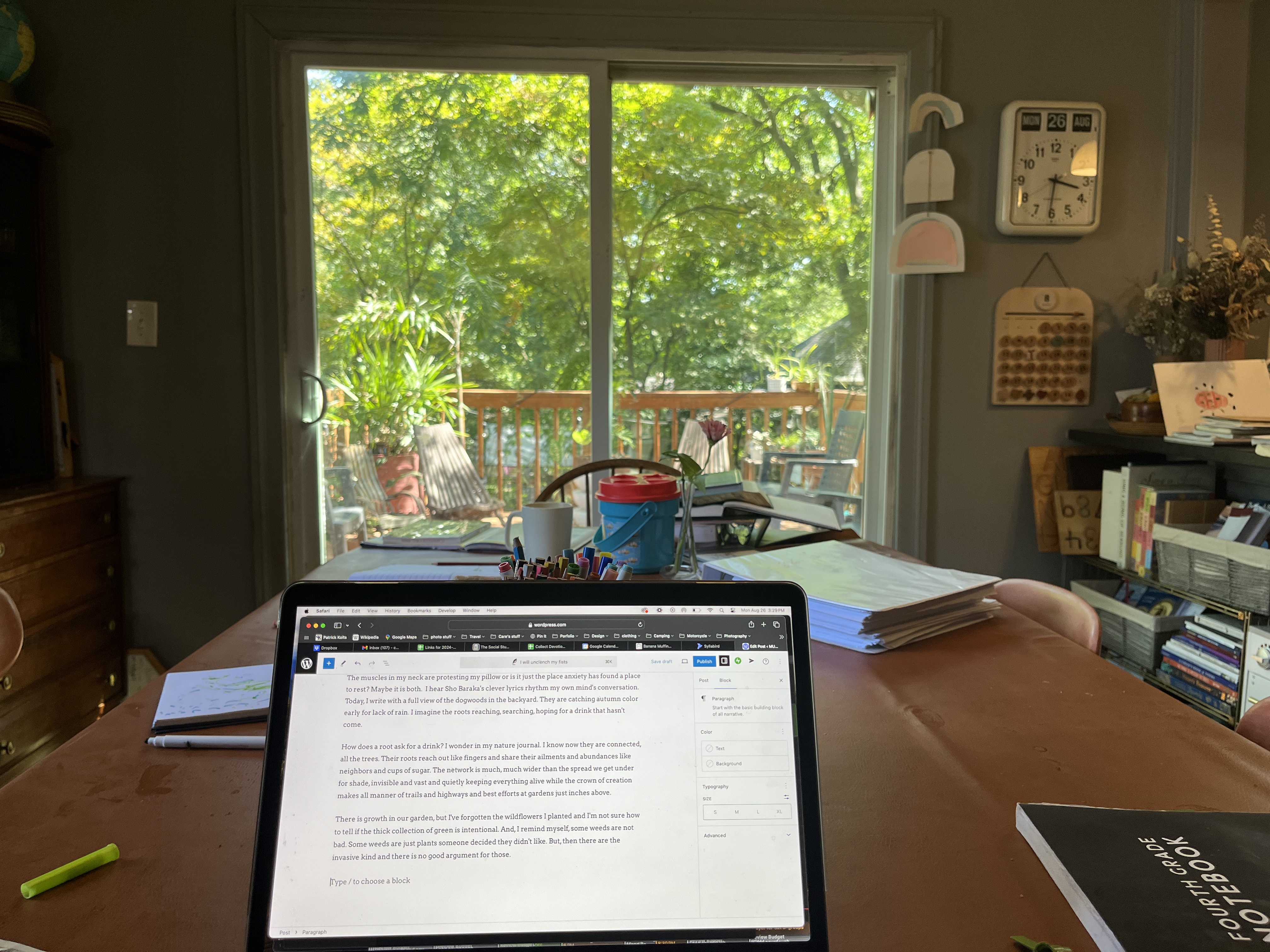
The muscles in my neck are protesting my pillow. Or, is it just the place anxiety has found to rest? Maybe it is both. I hear Sho Baraka’s clever lyrics rhythm my own mind’s conversation. Today, I write with a full view of the dogwoods in the backyard. They are catching autumn color early for lack of rain. I imagine the roots reaching, searching, hoping for a drink that hasn’t come.

How does a root ask for a drink? I wondered in my nature journal last week. I know now they are connected, all the trees. Their roots reach out like fingers and share their ailments and abundances like neighbors and cups of sugar. The network is much, much wider than the spread we get under for shade, invisible and vast and quietly keeping everything alive while the crown of creation makes all manner of trails and highways and best efforts at gardens just inches above.

There is growth in our garden, but I’ve forgotten the wildflowers I planted and I’m not sure how to tell if the thick collection of green is intentional. And, I remind myself, some weeds are not bad. Some weeds are just plants someone decided they didn’t like. But, then there are the invasive kind and there is no good argument for those.

I sketched a fly and a mosquito today as I sat with Foster for Science class. When my mind wants to make the wrong noise– to mirror the droop of my shoulders and the resignation in my throat– I look and listen for an invitation to the present moment. And there is always something. The leaves dancing in shadow on the deck chairs. Blue jays and cardinals and wrens chatting in the morning. We compare notes and sketches and try to figure out if I placed the legs in the right place, or are they arms? Feelers? Stingers? His web is an abstract attempt and I shoo away his apologies and disclaimers to pronounce it good.

And I wonder if he questions the authority I have to pronounce anything good. And he’s right. I don’t have any. I’m just a person.

Last night, I was sharing this idea I had with someone… where we would gather a list of questions from kids and then find real humans in our networks who could answer their questions. The idea, of course, is that within our networks we have vast, beautiful storehouses of knowledge and we could have our question answered by a human with eyeballs instead of a search bar with an interface.

“That’s so cool! What would your areas of expertise be?” he asked, like a gentle giant of fairy tales. Because, well, he is quite tall.

And I froze. I’m almost 40 and I am actually speechless when it comes to what I have to offer. Isn’t that funny? I mean, it’s hard to package “been rescued from a hike on a mountain where wild pumas roam free” and “taken multiple rides in cars with strangers” and “frequently attends theology and philosophy conferences without knowing a soul, not for a ed. requirement but just because” and “loves youth ministry, loves to dance” and “has kids, interest in spiritual formation.”

What I said was, “I’m not really sure. I have lots of questions! I just learned today that the dynamic of slavery in the Greco-Roman period could really change how we read Bible passages about freed people and how they relate to former owners and, therefore, how the message of the Gospel looked like an alien religion because it united people across classes in a way that nothing had ever done before. I’m interested in that!”

As I write that, I realize that what I said last night was more like, “Um, I learned this thing about Greco-Romans… interesting.. reading Ephesians…”

Does anyone have imposter syndrome about being human? I always think of Satan holding out some delectable sin– something sparkly and sinister and obvious. But, lately (always), it seems Satan has taken a more subtle tone with me. His garden question sounds more like, “But, were you actually worth making, compared to all this other glory He made? Did He really forgive you? Has God given you anything good to offer?”

And to be honest, there’s a lot of evidence stacked against me. My anger with the kids, my impatience with the ticking minutes, my resignation after a bad hour of the same work I was made to choose. It’s self-sabotage and Satan’s behind it. So, I speak it to the leaves and the sunshine on the dancing philodendron and the flies hovering above the dried smoothie on the table.

It’s this song, the bridge especially. And, there is no more time so this will publish unfinished but with these incredible beautiful harmonies.

when our souls can hug

“Ugh! Don’t you think it’s just so frustrating that we can never actually hug?!”

She’s acting out the question like it’s a modern dance prompt. “I mean, we’re just covered in molecules and there’s no real way that you… I mean the real you can really hug the real me! We’ll always just be separated by our skin!”

I’m not sure if I get the sweats because she’s so like me and I can so clearly visualize the mountains she’s climbing in her head OR if I get the sweats because she’s so unlike me which means there is a whole different set of mountains in there. Either way, I get overwhelmed by the barrage of questions and thoughts and the speed which is eerily similar to Rory from that one show I never watched in high school. The whole business of “we’re hugging but we’re not” was too existential for the post bedtime moment when it was introduced, so I shooed her off and snuggled into the end of one of three books on my nightstand.

Tonight, we walked the Beltline in search or Kombucha. Just two nerdy ladies making loud commentary on everything from fall weather to friendships to socially acceptable fraternizing.

“What’s singles night? Who goes to it? If you can get drunk on alcohol why do you drink it?” And she interrupts her own thoughts– “Oh, mom look! That place opened up! We’ve been waiting for it to open and now it is.. oh and looks like kind of a hula theme, okkkk! Oh, there’s the climbing gym. I sure love that place. And also why are there so many memberships but they are so expensive? You know, in heaven that will be so cool…

“Oh, you mean we will have all the memberships?”

“There won’t be any because we will all be in the same club!” I smile and she reaches for my hand. Now, we’re back to fall weather and sweaters and, oh! Here we are again. Back at molecules hugging.

“But, mom it really is awful that I’ll never actually be able to hug you. Like, really hug you, because we are just covered in skin and molecules and… ugh!”

“Wait, so you want our bones to hug? Our blood? What is it you envision hugging that would be more me than with my skin on?”

I was pushing, prodding… not because I knew what she would say and definitely not because I knew the answer (who even does know if molecules hug?). Today, she learned about dust mites (thank you Science class for introducing us to a world of terrors we cannot see) and she’s convinced we are all being “hugged” by tiny, terrible insects most of the time. Gross. But no, I think I was pushing because I was genuinely curious about where her thoughts would land.

“No, not blood and bones! I don’t know… Maybe, I don’t know, maybe I wish our souls could hug! Is that it? Like I just really think there is so much in between us kind of.”

“That’s it!” I said maybe a little too loud but it was okay because the DJ at the singles night was bumping. “I think I get what you’re saying!” And all at once we both summited a mountain in cozy sweaters in our separate brains and I realized God is seeing me, loving me, tending me, through the mind of this exquisite young lady. And I can see her a little bit more clearly in all her bursting, 9-year-old glory.

Indeed, what a wonderful day it will be, Zella Ruth, when our souls can finally hug.

the news is good because of the Giver

The stress of Sunday felt like a 7 layer dip I got buried inside. We rolled out of church just before the lights shut off (as per uzh) and Pat looked at me and said “Should we get doughn–?” and I interrupted with, “Well, I don’t really want to clean u–” and then he said, “So, pizza?” and I was like, “…invite Margaret!”

We were all like, “yeah, totally YES AND!” in those beautifully spiritual words of improv. And after pizza and catching up with our friend, we had to stop for eucalyptus and then also garland and then by the time we got home… well, there wasn’t much time for sabbath rest before dinner and hosting preparations began.

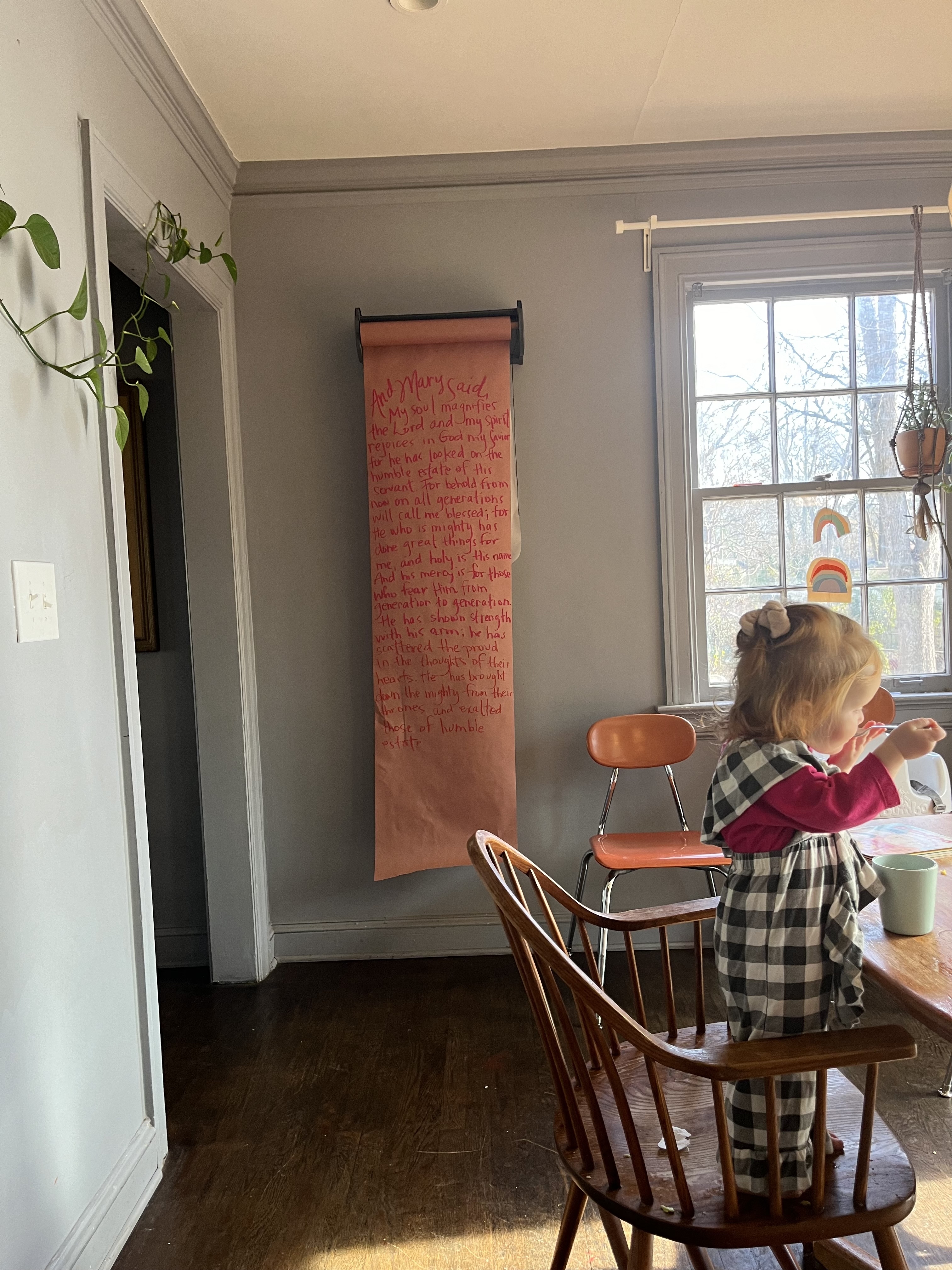
I wrote the Magnificat on butcher paper in pink to acknowledge the subtle relief we feel this week as we light the candle of Joy. I found myself pausing, even as I haphazardly decided to bake and frost cookies with sprinkles an hour before people were supposed to arrive. My pausing was a mental one, connecting the bright dots of light across the sky behind my eyes and seeing a picture emerge while the chaos of color and sound happened in my view.

Constellations. It’s the best way I can explain how something can connect so completely inside my spirit that I am almost convinced I’ve known before and forgotten. And as I traced dots of light in my mind’s sky, I saw a different way to consider the absurdity of Mary’s worship. The news that she would give birth to the son of God was actually the worst news for her reputation and for conversations at family gatherings and for a “honeymoon” stage of marriage and for her young body that would shapeshift to hold the baby. When I asked the kids Sunday night what emotions she might have felt when receiving the news from the angel, they answered the way I always have, “Scared!” … “Nervous!” … “Confused!” … “Afraid!” and their answers hung just under the strings of eucalyptus and leaves and evergreen branches on the ceiling.

And yet, I have no problem picturing her joy because I’m on THIS SIDE of Jesus’s birth. I know it will be ok. I know she will be an outcast, but she will also be visited by shepherds and angels and far away kings. I know the crude manger scene will give way to assimilating into some sort of regular life where he gets left at the temple, teaching rabbis. I know her Son, my Savior will be the Messiah because I believe the historical fact of his birth and kingship more easily as I look backward. I am believing with the whole picture of what He came to accomplish and living in light of His victory over the grave.

But, Mary.

She may not have known that her baby boy would one day walk on water, but she did know the character of the One who made the waters and the winters and the womb home inside her where Jesus would reside. She did not know most things about how the Savior would do the saving. But as she is caught up (and us with her) in her song of joy, I am struck by how her worship was fueled by all she did know about her God.

The news was not good in the way we might celebrate the joys (ahem…success) of the past year on a Christmas card: job promotions, marriage, babies, trips, renovations, awards and Pinterest worthy hosting events. Mary’s update to her family and friends might have read something like, “This year, angels appeared miraculously to Joseph and me to tell us we would be the parents of God’s son, Jesus. We are overjoyed! We write to you from a long, lonely walk to Bethlehem and hope that we can find lodging there. We have had a hard time finding work and maintaining friends, but we are hopeful that someday soon you can join us in this joy that we know to have come from the Maker Himself. It is truly amazing!” She probably wouldn’t even write the sad parts which read passive aggressive now, as I read them back.

Mary’s joy somehow sat beside, and was not overshadowed by, the sorrow in her heart. And though this news would flip her life like a temple table in Jesus’ hands, she stepped into the miracle of it and sang for joy. I wonder if, like the words of Elizabeth when their wombs met, their access to such joy came because they weren’t afraid it would displace the appropriate ache of all the other things. The injustices in the land. Stress and tension among family. The sorrow of lost loved ones. The pain of estrangement. The everyday toil of torn muscles and stretching work schedules.

It was past dinnertime last night, our guests were running late and Pat would be walking in just moments before their arrival. I was a flurry of motion, praying the paprika chicken would be edible while I made dough balls for naan and let Vesper run between my legs. I spoke slowly and directly and sternly to the children in my charge, “I need your help. I’m asking you to help me because I cannot do this alone.” The crack in my armor was showing and Zella responded in her too-grown way, “Mom, you seem stressed. Ok, let’s say 5 things we’re thankful for, ok?”

Anger boiled behind my slow breaths, because I don’t run a tight ship in my house and it felt like we were sinking. But, her words glittered like stars in the darkened sky of my anger, above the sinking ship of my house. Somehow, by the grace of God, prayers of a friend and my daughter’s convicting words, we righted the ship under a less sailors-take-warning kind of sky. The pride and the pain in me are resistant to Mary’s type of worship because I want to know, “exactly how, God?” How will this turn out good, in the end? I don’t see your purpose in it. I don’t understand my role in it. I can’t work out the specifics of this type of saving.

But what Mary knew was enough: the giver of the News is what makes it Good.

God, heal my unbelief.

P.S. Dinner was fine. It was more than fine, it was wonderful. Both Advent and our guests last night were truly a gift from the One who knows my name. And I am humbled because I could have worshipped before I knew that the chicken was delicious and the kids would warm to candlelit trivia about Mary and our living room would fill with joy and honest prayers. I missed that opportunity, but I pray I won’t miss the next one. When I receive the words (however they come) that God is good, I pray my first words are rejoicing ones.

signs of life

Sun is speckling, slanting across the kitchen counter, then the dining table, the dresser in the bedroom and now the smudged glass of the hutch. A clock counting the daylight hours, I count too. My eyes follow the golden spotlights and the shadows.

“Christ is Light!” The second littlest proclaims after dinner. “In Him there is no darkness,” we respond. What a ride candles are with little kids. On Sunday’s advent dinner, a mess of fingers rushed for the lighter, the precarious (yet very cool, vintage) five candle holder dipped and dived as a separate mess of fingers held it “steady” for lighting. Life.

Outside, the rain and clouds made it feel like night around 4 pm, winter cold hanging in the damp dark. Inside, the oven was still warm and I opened the kitchen window to invite a breeze between our bodies. We were many, filling out every room and spilling potluck dishes on every counter. Abundance. Inside the dark day, inside the dark season, inside the dark world– we are bright defiance. Pièces de résistance.

Our neighbors shared a tip a few years ago after we gave them a young crepe myrtle from the abundance we dug up from an acreage “thinning their plants for maintenance reasons.” (Praise be!) When we apologized to our neighbors because we thought maybe the tree we gave them didn’t survive the uproot and replant process, they said, “Oh, actually… it looks dead, but if you just scrape the bark you can see it is green underneath. Ours is alive, so we think it’ll have leaves in the spring!” Praise. We ran to see if ours survived, too.

Our front lawn is a sad mess of wet, brown pecan leaves. We are now choosing to compost our leaves by doing absolutely nothing about their gathering every fall, but it does not look good or tidy or festive. We shoved our shoes in their cubbies and under dressers so that there was space on the mat for the friends who would come for advent dinner Sunday. We knelt to pray at 5:45 pm as a family that God would help us be good hosts, even if it was a small group. That little rubber mat didn’t stand a chance. The shoes piled as the plates filled and I had to walk sideways in order to make the circle from dining to living room and back again. Warmth stretched out from my middle, as Pat prayed for the provisions and kids crawled out from under tables.

We ate well and drank deep in that special, winter potluck way and then huddled together to mark another week of advent– to name the shadows where light appears to have faded almost completely in this present darkness. We prayed peace into wars and sibling fights and meanness and anger. We prayed peace where it is impossible. We prayed for miracles.

“All is not lost. Mm-mm.”

My body sags with the desperation of it, now Tuesday and sunlit. But it is still advent dark. Our prayers for peace inside wars and fights and meanness and anger, well… It is still advent dark. So, I hear this song on repeat and remember that planting seeds of peace is obedience.

We prayed the Collect to finish out our time on Sunday. I’m still learning these rhythms.

BLESSED Lord, who has caused all holy Scriptures to be written for our learning: Grant us so to hear them, read, mark, learn, and inwardly digest them, that by patience and comfort of your holy Word, we may embrace and ever hold fast the blessed hope of everlasting life, which you have given us in our Savior Jesus Christ. Amen.

The time for teaching moments had passed. The kids attached well to the illustration from Isaiah 11 that Jesse proclaimed over the group, “The lion shall lie down with the lamb… the wolf and the goat… the baby and the cobra…” These are not relationships of peace in the kingdom of the world. This vision is the hope of a peace that Christ accomplished being fully realized on this earth– every inch of it. Their right answers earned them a Ukrainian chocolate that some of our guests brought to share from their home country. God be praised, but those kids weren’t hearing more lesson. So, we simply spoke the collect together. We let the words rise in a chorus above our heads, an unlikely choir of ages and stages and backgrounds. And, we may not have known it, but we were praying for the seed to be planted in us. We prayed that the Word would actually take root in us, so that we ourselves could be the very planting of the peace that Christ accomplished.

May these seeds defy the flippant scattering and the death underground and the complicated germination and the unlikely conditions and the hungry squirrels– may these seeds of peace sown in obedience bring about an otherworldly rest for the weary, the war-torn, the wintered and the waiting.

Advent is still so dark. When there is no sign of life, may Christ light the way to plant the seeds of peace. AMEN.

when I shout my lonely office

It’s full again. I empty the Dyson and the dust puffs up in my face. I check the simmering onion and garlic with a glance, tie the red strings and lift the garbage with my good arm while I close the door under the sink with my foot. Vesper is still boundary training. I throw a towel over the naan dough and pray it’s clean enough, and then rush out the front door in sock feet to sling the bag at the bottom of the front steps. Before I bend-snap my shoulders back up above my hips, I clock the distance to the garbage can.

The red, stretched out strings find my fingers and I take the long way– sidewalk, pavers, retaining wall before slinging the bag with my bad arm, careful not to rotate it too far above my shoulder. By the time I race my socks back inside, the garlic has nearly gone but can still be saved. Praise. Curry tonight and it’s got to be a swift and substitution-heavy turn around for our meal.

My mind wanders back to Robert Hayden. Lines from the poem yesterday are alighting like the chickadee bird of our school research today. Foster tells me that chickadees are so smooth in flight you can’t hear them. I imagine a chickadee might surprise me with its presence, though if I had eyes to see or ears to hear I might have noticed its arrival.

What did I know, what did I know
of love’s austere and lonely offices?

Robert Hayden in “Those Winter Sundays”

What do I know, about serving with a heart that doesn’t keep track of the broom sweeps and the simmered garlics and the nuance of a day’s schedule. What do I know of love’s lonely office? Still little, maybe nothing.

The office I keep is haphazard and more Jekyll + Hyde vibe than I would like, than I hoped… than I claimed for my future when I was envisioning this phase. I am not what I envisioned. I’ll say that, for sure. I’m far worse. Where has all the wisdom gone? That’s what I asked of Solomon over peppermint tea at Kiara’s house as we studied prophets in the Old Testament and somehow landed on Solomon’s backsliding. The man literally asked God for wisdom and was granted it and STILL he ended up with 700 wives and who knows what else in his disobedience. What we do know is the little letters in the text cannot contain the havoc his sin wreaked. Somehow, he got less wise as he got older! I sipped my tea and passed judgment and then listened as my sisters shared that shrinking in wisdom was a bit of an epidemic.

We’re into our morning now, breakfast and reading aloud and prayers. I committed to ignore my phone until scripture finds my face in the morning, so the world could be ending and I am blissfully unaware for the next 17 minutes. We’re out of order, but we’re in the first week of advent school, so everything feels a bit disjointed. I come to our Scripture this week and we read from Isaiah 11.

I thought it would be a few verses, but as I am reading I become animated. I lean dramatic, so a prophetic passage can’t be appropriately delivered sitting down. “Righteousness will be the belt of his waist!” I proclaim as I motion for a giant belt securing my middle. “And faithfulness the belt of his loins!” I know less where to motion for this but I am dramatic, still. The whole passage comes alive in front of me– the impossibility of a Savior, the unlikelihood of people being around to even be looking for one. And yet the prophet paints the picture.

These are the words that had to be repeated, from generation to generation to generation to generation. Words guarded and savored like secret recipes passed down with a knowledge of their potency, their flavor and power. These words of the prophets were the words for all the years of silence, when the mornings and the noondays and the evenings seemed only dark. When the ordinary going out and coming in required belief in a faithful God who had spoken promises, but had stopped speaking.

Can you believe this? 700 years before Jesus came and THESE words were given to the prophet Isaiah? Wow, but do you see? I am jumping now and they are laughing. Praise God for laughter as it shakes off offenses of spilled milk and withheld apologies. These words about who? “Jesus,” they say. Yes! And when Jesus came did all the dark go away?

At this, they are not quite sure. It feels like the pep rally answer is YES but that somehow doesn’t feel true. That’s what I’m sensing in their faces at least. I get a mumbled majority, “No?” like a question. That’s right! When Jesus came into our darkness, fulfilling this prophecy, the darkness did not go away. But, he did give us a way out. He did open a door so we didn’t have to stay in this darkness forever.

And I felt alive in a new way. A mess of wires behind my ribs connected again and I felt the power of hope. Hope? What an impossible thing to hold.

There shall come forth a shoot from the stump of Jesse,
    and a branch from his roots shall bear fruit.
And the Spirit of the Lord shall rest upon him,
    the Spirit of wisdom and understanding,
    the Spirit of counsel and might,
    the Spirit of knowledge and the fear of the Lord.
And his delight shall be in the fear of the Lord.
He shall not judge by what his eyes see,
    or decide disputes by what his ears hear,
but with righteousness he shall judge the poor,
    and decide with equity for the meek of the earth;
and he shall strike the earth with the rod of his mouth,
    and with the breath of his lips he shall kill the wicked.
Righteousness shall be the belt of his waist,
    and faithfulness the belt of his loins.

Isaiah 11:1-5

This is the righteousness that will expose the wars within and without of my bones. My lack of love in my lonely office and the languishing faces of those despairing. This Jesus, the door out of the darkness, invites me come and walk with him. And I review my steps. Simmering garlic, running sock feet errands, reciting prophetic words, alone and lonely in a house full of disciples. The thoughts all tumble back down in the mental jenga game as Pat gets home from work and we sit down to pray over our curry while I take the naan out the oven foolishly with my fingers.

Something about conviction that I need to be seen and noticed and it’s not enough that God knows. I’ll return to it tonight, maybe tomorrow? I know it is an important thought about the poem, but now there is a basketball game for our dear Miles. Sweep the rice, clean the plates, sock the kids, and make a sign that says, “Go Miles!”

What do I know? It’s advent and the darkness is not hiding.