the news is good because of the Giver

The stress of Sunday felt like a 7 layer dip I got buried inside. We rolled out of church just before the lights shut off (as per uzh) and Pat looked at me and said “Should we get doughn–?” and I interrupted with, “Well, I don’t really want to clean u–” and then he said, “So, pizza?” and I was like, “…invite Margaret!”

We were all like, “yeah, totally YES AND!” in those beautifully spiritual words of improv. And after pizza and catching up with our friend, we had to stop for eucalyptus and then also garland and then by the time we got home… well, there wasn’t much time for sabbath rest before dinner and hosting preparations began.

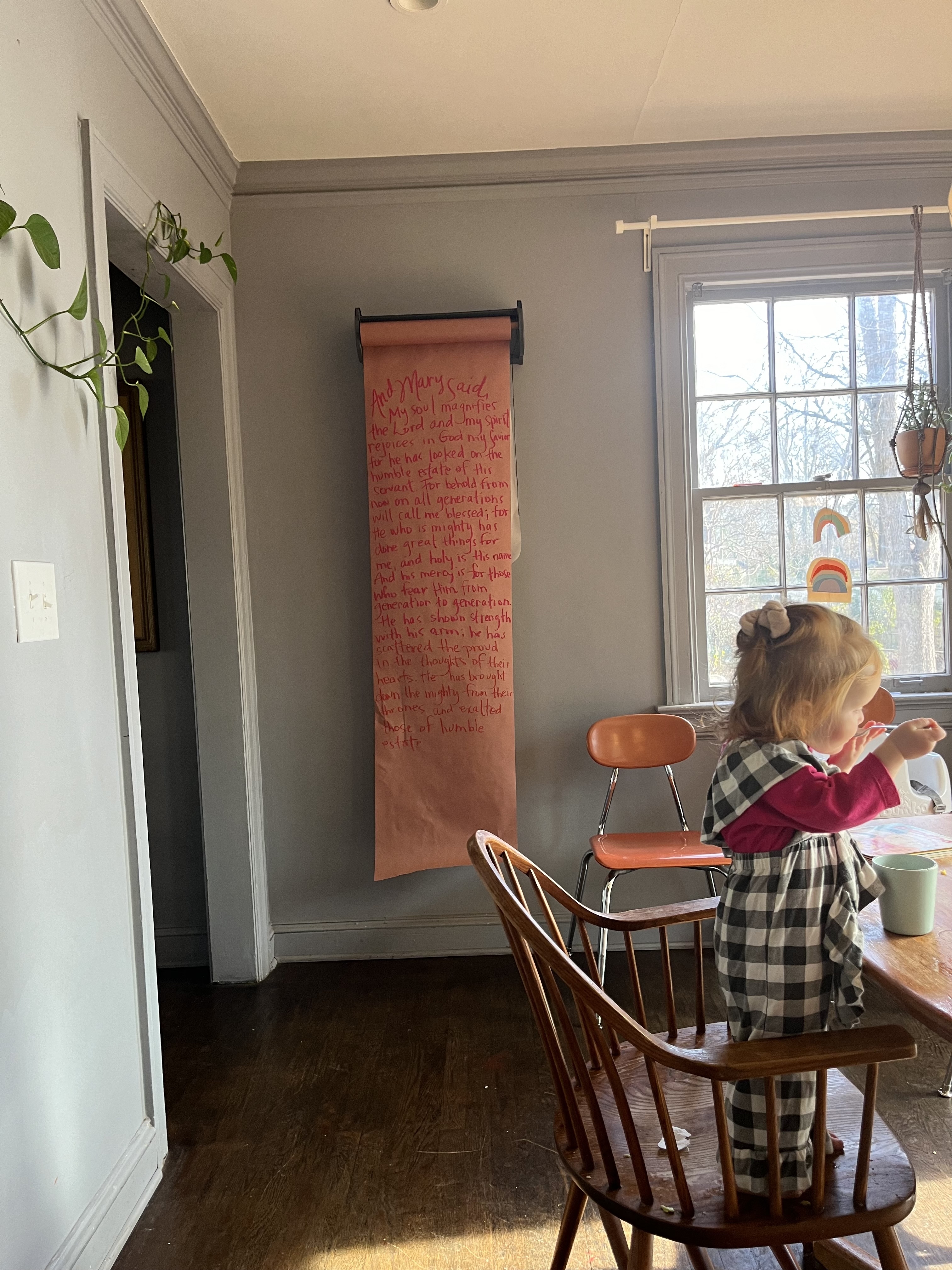
I wrote the Magnificat on butcher paper in pink to acknowledge the subtle relief we feel this week as we light the candle of Joy. I found myself pausing, even as I haphazardly decided to bake and frost cookies with sprinkles an hour before people were supposed to arrive. My pausing was a mental one, connecting the bright dots of light across the sky behind my eyes and seeing a picture emerge while the chaos of color and sound happened in my view.

Constellations. It’s the best way I can explain how something can connect so completely inside my spirit that I am almost convinced I’ve known before and forgotten. And as I traced dots of light in my mind’s sky, I saw a different way to consider the absurdity of Mary’s worship. The news that she would give birth to the son of God was actually the worst news for her reputation and for conversations at family gatherings and for a “honeymoon” stage of marriage and for her young body that would shapeshift to hold the baby. When I asked the kids Sunday night what emotions she might have felt when receiving the news from the angel, they answered the way I always have, “Scared!” … “Nervous!” … “Confused!” … “Afraid!” and their answers hung just under the strings of eucalyptus and leaves and evergreen branches on the ceiling.

And yet, I have no problem picturing her joy because I’m on THIS SIDE of Jesus’s birth. I know it will be ok. I know she will be an outcast, but she will also be visited by shepherds and angels and far away kings. I know the crude manger scene will give way to assimilating into some sort of regular life where he gets left at the temple, teaching rabbis. I know her Son, my Savior will be the Messiah because I believe the historical fact of his birth and kingship more easily as I look backward. I am believing with the whole picture of what He came to accomplish and living in light of His victory over the grave.

But, Mary.

She may not have known that her baby boy would one day walk on water, but she did know the character of the One who made the waters and the winters and the womb home inside her where Jesus would reside. She did not know most things about how the Savior would do the saving. But as she is caught up (and us with her) in her song of joy, I am struck by how her worship was fueled by all she did know about her God.

The news was not good in the way we might celebrate the joys (ahem…success) of the past year on a Christmas card: job promotions, marriage, babies, trips, renovations, awards and Pinterest worthy hosting events. Mary’s update to her family and friends might have read something like, “This year, angels appeared miraculously to Joseph and me to tell us we would be the parents of God’s son, Jesus. We are overjoyed! We write to you from a long, lonely walk to Bethlehem and hope that we can find lodging there. We have had a hard time finding work and maintaining friends, but we are hopeful that someday soon you can join us in this joy that we know to have come from the Maker Himself. It is truly amazing!” She probably wouldn’t even write the sad parts which read passive aggressive now, as I read them back.

Mary’s joy somehow sat beside, and was not overshadowed by, the sorrow in her heart. And though this news would flip her life like a temple table in Jesus’ hands, she stepped into the miracle of it and sang for joy. I wonder if, like the words of Elizabeth when their wombs met, their access to such joy came because they weren’t afraid it would displace the appropriate ache of all the other things. The injustices in the land. Stress and tension among family. The sorrow of lost loved ones. The pain of estrangement. The everyday toil of torn muscles and stretching work schedules.

It was past dinnertime last night, our guests were running late and Pat would be walking in just moments before their arrival. I was a flurry of motion, praying the paprika chicken would be edible while I made dough balls for naan and let Vesper run between my legs. I spoke slowly and directly and sternly to the children in my charge, “I need your help. I’m asking you to help me because I cannot do this alone.” The crack in my armor was showing and Zella responded in her too-grown way, “Mom, you seem stressed. Ok, let’s say 5 things we’re thankful for, ok?”

Anger boiled behind my slow breaths, because I don’t run a tight ship in my house and it felt like we were sinking. But, her words glittered like stars in the darkened sky of my anger, above the sinking ship of my house. Somehow, by the grace of God, prayers of a friend and my daughter’s convicting words, we righted the ship under a less sailors-take-warning kind of sky. The pride and the pain in me are resistant to Mary’s type of worship because I want to know, “exactly how, God?” How will this turn out good, in the end? I don’t see your purpose in it. I don’t understand my role in it. I can’t work out the specifics of this type of saving.

But what Mary knew was enough: the giver of the News is what makes it Good.

God, heal my unbelief.
P.S. Dinner was fine. It was more than fine, it was wonderful. Both Advent and our guests last night were truly a gift from the One who knows my name. And I am humbled because I could have worshipped before I knew that the chicken was delicious and the kids would warm to candlelit trivia about Mary and our living room would fill with joy and honest prayers. I missed that opportunity, but I pray I won’t miss the next one. When I receive the words (however they come) that God is good, I pray my first words are rejoicing ones.

Christ the Breaker, Peacemaker

Winter becomes official next week, the darkest day of the year signaling its arrival. I expect gloomy days and meet sunshine with skepticism. The pecans and dogwoods reach crooked angles up into the sky and the crepe myrtle stands like a skeleton. Does nature choose to be wintered? It seems to just happen, despite its own transformation every year into full spring and summer beauty. Does nature feel the death of it, before the life of it breaks forth?

We’re studying animals in winter for school and I’m convinced they have a better bodily understanding of the season than humans because they aren’t distracted by sweater weather and hallmark movies. They are fully present, doing the work of preparing and then presiding over their bodies when the elements are against them. The painted turtle plans a winter without air, deep in the cold mud under a frozen pond where the it will stay for 6 months until spring without breathing once. The American black bear will give birth to young while asleep in hibernation. Other animals are less dramatic, but none of them are escaping their bodily realities.

We still hear birdsong here in December, just slower and spaced out. We see the occasional Flying V formation overhead, late arrivals for a warmer winter home. Their melodies bounce across the neighborhood— their chatter lilts and pauses, comes forward and then fades behind children and cars and planes high above. Is the sky the backdrop to their dramatic song or is the song the accompaniment to the early nightfall?

We make our deliveries, down Langston and across Sylvan Pl and the kids do some of it while I peek through the front window. I can’t figure out how to teach Foster his letter sounds while making bread and tending the baby, but I am humbled by my love again with this life— with this neighborhood and its trees, with our neighbor friends and the honesty of this time of year. The liturgical year is my insides turned out— my heart’s constant forgetfulness of God’s condescension and redemption needs the rhythm of Advent and Christmas and Epiphany and Lent and Easter to stay in step with the Spirit.

And I love Advent— the heavy despair and ache of it against the backdrop of tinsel and lights and holiday parties. I like the idea of making my body to bend, to form my longing for help into the shape of kneeling because all the lists and goals and scribbled schedule maps get lost in stacks of watercolor paintings and play dough scraps. I reach for a grid outside the one I would make myself because in mine I am the master of ceremony. I am the one who leads the way.

“The One who breaks open the way will go up before them;
    they will break through the gate and go out.
Their King will pass through before them,
    the Lord at their head.” Micah 2:13

Here, in Advent, I meet Christ the Breaker— the King who leads the way. As the well-known characters of the Christmas story find their place on the hill and the camel journey and in the manger scene, I plod through these days both aware of the complete miracle of existing and aware of my cavalier attitude toward my Maker’s God-made-flesh reality and promised coming again.

The King’s coming would make a way for us, but it didn’t look like the Red Sea. He had already done that. Centuries and generations of miracles and signs and wonders and parted seas. The scene closes in Malachi with all the drama of a finale. These words shake the core of me, picturing all those Ebenezer towers and oral histories that crowd the Old Testament pages.

“For behold, the day is coming, burning like an oven, when all the arrogant and all evildoers will be stubble. The day that is coming shall set them ablaze, says the LORD of hosts, so that it will leave them neither root nor branch. But for you who fear my name, the sun of righteousness shall rise with healing in its wings. You shall go out leaping like calves from the stall. 3 And you shall tread down the wicked, for they will be ashes under the soles of your feet, on the day when I act, says the LORD of hosts.
“Remember the law of my servant Moses, the statutes and rules that I commanded him at Horeb for all Israel. “Behold, I will send you Elijah the prophet before the great and awesome day of the LORD comes. And he will turn the hearts of fathers to their children and the hearts of children to their fathers, lest I come and strike the land with a decree of utter destruction.”

Malachi 4:1-6

And then, nothing.

No response to their questions or pleas or praise, just… silence. But, I imagine the families of those who held on to hope would speak these words to each other. I imagine in the ordinary making of bread and tending of sheep and exchanging goods at the market, there were families who feared the Lord, desperately holding on to hope that He would not be silent forever. And with each generation, I imagine the longing grew for the unfettered joy of a newborn calf set free from a stall. “The sun of righteousness will rise, with healing in his wings,” but Christ the Breaker would not come with a glorious entourage and resplendent power.

Jesus was growing inside a womb as a baby and would come into the world through a birth canal. The fullness of time was his due date. The King’s going up before me sounds like the soft lantern light on a warm, summer night. But, I wonder if His making a way is more like a bushwhacker … because the evil is thick. The hurt is not a morning fog but an advancing army. And Hope is so impossible— an insult, almost, to the depth of despair. For the Israelites, that depth lasted 400 years. And they are not alone in their suffering. We join brothers and sisters, a cloud of witnesses the world over and throughout history who sit in a place of longing before a holy God, believing He will rescue them but not knowing when.

The peace we long for, the peace we find in Christ, is forged with active rebellion against the evil forces of the world that would rather war. “For He himself is our peace, who has made us both one and has broken down in his flesh the dividing wall of hostility.” Ephesians 2:14

We are loved by the One who promised to make Peace for us with God forever so that we can make peace today exactly where we are.

The Sabbath soup sits on the stove, preparations are made for a day of rest tomorrow before Advent dinner begins in the evening. A series of fortunate events today meant that we had company for much of our preparation and guests for sabbath dinner. We guessed on the masala chicken, let the baguettes boast an extra crunchy crumb, and tried a new granola recipe. We fluttered from room to room and explained again that we are a team and we are preparing to enjoy a day of rest tomorrow. We followed behind helpers and helped their helping. I confessed, again, at dinner my impatience this week and I’m sad to hear the words in my mouth.

We will light a candle of joy tomorrow and I will kneel now in prayer. And, God, would you help me get behind you as you do the Breaking and the Peacemaking?

signs of life

Sun is speckling, slanting across the kitchen counter, then the dining table, the dresser in the bedroom and now the smudged glass of the hutch. A clock counting the daylight hours, I count too. My eyes follow the golden spotlights and the shadows.

“Christ is Light!” The second littlest proclaims after dinner. “In Him there is no darkness,” we respond. What a ride candles are with little kids. On Sunday’s advent dinner, a mess of fingers rushed for the lighter, the precarious (yet very cool, vintage) five candle holder dipped and dived as a separate mess of fingers held it “steady” for lighting. Life.

Outside, the rain and clouds made it feel like night around 4 pm, winter cold hanging in the damp dark. Inside, the oven was still warm and I opened the kitchen window to invite a breeze between our bodies. We were many, filling out every room and spilling potluck dishes on every counter. Abundance. Inside the dark day, inside the dark season, inside the dark world– we are bright defiance. Pièces de résistance.

Our neighbors shared a tip a few years ago after we gave them a young crepe myrtle from the abundance we dug up from an acreage “thinning their plants for maintenance reasons.” (Praise be!) When we apologized to our neighbors because we thought maybe the tree we gave them didn’t survive the uproot and replant process, they said, “Oh, actually… it looks dead, but if you just scrape the bark you can see it is green underneath. Ours is alive, so we think it’ll have leaves in the spring!” Praise. We ran to see if ours survived, too.

Our front lawn is a sad mess of wet, brown pecan leaves. We are now choosing to compost our leaves by doing absolutely nothing about their gathering every fall, but it does not look good or tidy or festive. We shoved our shoes in their cubbies and under dressers so that there was space on the mat for the friends who would come for advent dinner Sunday. We knelt to pray at 5:45 pm as a family that God would help us be good hosts, even if it was a small group. That little rubber mat didn’t stand a chance. The shoes piled as the plates filled and I had to walk sideways in order to make the circle from dining to living room and back again. Warmth stretched out from my middle, as Pat prayed for the provisions and kids crawled out from under tables.

We ate well and drank deep in that special, winter potluck way and then huddled together to mark another week of advent– to name the shadows where light appears to have faded almost completely in this present darkness. We prayed peace into wars and sibling fights and meanness and anger. We prayed peace where it is impossible. We prayed for miracles.

“All is not lost. Mm-mm.”

My body sags with the desperation of it, now Tuesday and sunlit. But it is still advent dark. Our prayers for peace inside wars and fights and meanness and anger, well… It is still advent dark. So, I hear this song on repeat and remember that planting seeds of peace is obedience.

We prayed the Collect to finish out our time on Sunday. I’m still learning these rhythms.

BLESSED Lord, who has caused all holy Scriptures to be written for our learning: Grant us so to hear them, read, mark, learn, and inwardly digest them, that by patience and comfort of your holy Word, we may embrace and ever hold fast the blessed hope of everlasting life, which you have given us in our Savior Jesus Christ. Amen.

The time for teaching moments had passed. The kids attached well to the illustration from Isaiah 11 that Jesse proclaimed over the group, “The lion shall lie down with the lamb… the wolf and the goat… the baby and the cobra…” These are not relationships of peace in the kingdom of the world. This vision is the hope of a peace that Christ accomplished being fully realized on this earth– every inch of it. Their right answers earned them a Ukrainian chocolate that some of our guests brought to share from their home country. God be praised, but those kids weren’t hearing more lesson. So, we simply spoke the collect together. We let the words rise in a chorus above our heads, an unlikely choir of ages and stages and backgrounds. And, we may not have known it, but we were praying for the seed to be planted in us. We prayed that the Word would actually take root in us, so that we ourselves could be the very planting of the peace that Christ accomplished.

May these seeds defy the flippant scattering and the death underground and the complicated germination and the unlikely conditions and the hungry squirrels– may these seeds of peace sown in obedience bring about an otherworldly rest for the weary, the war-torn, the wintered and the waiting.

Advent is still so dark. When there is no sign of life, may Christ light the way to plant the seeds of peace. AMEN.

no better place

There is no place like home, it’s true. There is a familiar comfort in a cozy corner or books arranged systematically in a way no other human soul could understand or the steam rising from a freshly baked loaf cooling on the counter. But sometimes home isn’t home enough. It’s unexplainably lonely and cold and quiet, even as the joyful shouts of children smother your thoughts and you shuffle around with three layers of your husband’s socks. Just me?

How lovely is your dwelling place, Lord Almighty! My soul yearns, even faints, for the courts of the Lord; my heart and my flesh cry out for the living God. Even the sparrow has found a home, and the swallow a nest for herself, where she may have her young— a place near your altar, Lord Almighty, my King and my God. Blessed are those who dwell in your house; they are ever praising you.

Psalm 84:1-4

This morning, after a mess and tangle of extra limbs in my bed and water requests before I opened my eyes, I remembered my home. I put the water on to boil, measured the coffee extra strong, and gave my littlest ones cereal in bowls with milk that I mentally prepared to clean up off the floor because they wanted to share a chair. Muscle memory pre-heated the oven to 460, because I have a hunch my oven runs cold. I formed the dough while the hot water rested, then rested the dough while I ground the coffee.

And, I thought of home. It’s a refuge I know well, but a place I have never lived. It’s the home God made for me and where my heart rests its head sometimes without my body fully participating. And it feels so desperately far from where I am. I sang the words with my winter-cold voice and it cracked extra as I achieved a level above the din of hide-and-seek madness circling three rooms.

I wanna be in Your presence, I wanna be near Your heart
I wanna know You’re close even when I’m feeling far
I don’t want what this world would offer, I want the living God
‘Cause there’s no place better than where You are

from Caroline Cobb’s “No Better Place”

I poured fluid ounces of meticulously heated water over coffee grounds and I cried. “Do I?” The thought surprised me, like reaching deep back into the freezer for a chocolate long hidden only to turn around to meet a child’s curious gaze. Shame and love warred for a moment– and I paused, wondering what my exposure would produce in me. I sang again, believing that singing my love for home would remind my heart where I belonged.

As I prepare for advent this year, I’m listening. I’m listening to Howard Thurman and Tish Harrison Warren and Fleming Rutledge. I am listening to old saints and seekers, monks and martyrs. And I am yearning with them for home. I am believing with them that Light has come, will come and is a Light that cannot be overcome. This is the Light that illuminates my true home. My yearning for this home feels fragile– wrapped as it is in my human understanding.

As I listen to others, I also hear my own condemnation. No matter how much I know, how many times the Spirit convicts, how often I face the facts of spiritual failure in my own life, I cannot accomplish my own mending. The ripped garments of my choosing can only be repaired with the torn veil of the Temple and the broken flesh of a Savior. And, those tiny words formed in a question hidden in the noisy kitchen chaos this morning, beckoned me, “come.”

Come, child. Come sit inside my mending. Come repent and rest. Come without all your defenses and reasons. Just come be in this Light and know that the exposure allows you to see, actually see the home I’ve made for you. Be here. Be with me. Sit with me. Listen to me. Come, child. Listen to the stories I tell of a world I made right, a world I am setting to right, a world I am actively mending by the blood of my Son, Jesus.

Warren writes about the prophet Isaiah pairing repentance and rest (Isaiah 30:15) and how it might seem curious at first. We might assume that turning from sin is work. It makes sense, because resisting temptation is work. But, in our turning we are also accepting the joy of the true work accomplished. In Christ, our repentance is not work but freedom. In Christ, we walk through an open door to be both fully exposed and fully at rest. Home. Not a home with dusty corners or shadows or shame. The home we have in Christ is rest and my body relaxes into a deep and yearning sadness to be fully arrived mind, body and soul. There is no better place.

Now, I return to the hide-and-seek madness as we prepare for Sabbath. A little one will sit on my hip as I vacuum and another will keep me company on the kitchen floor while I clean and bake. I will tend the sick one with sips of Sprite and listen as another regales me with tales of the worlds inside her books. I will share elbow space with my partner as we set to the tasks of the day. And I pray all day I will hear the refrain, “there is no better place” and think of the invitation into the Lord’s presence somehow, mysteriously, in the midst of it all.

the liturgy of ordinary time

I am keeping track of time, barely. Sweat drops and slices of fruit and sips from iced cold brew. Molasses and moonshine; slow, fast, strong, fragrant.

My fingers tickle the contours of her face. Feather soft eyebrows, a tender dip in the bridge of her nose, a jaw line that hides under squishy cheeks, and her little jut of a chin with a bumpy, brave scar. We started the tickle when she was tiny. Maybe it was one of those long car rides from Iowa to New York when I realized she loved all kinds of soft touch. Then it got bundled up with her night and nap routines and now she makes specific requests. “Tickle my hands, Mama.” 

Most days, I count it a privilege and the tickle is sweet and slow and savored. Every once in a while, I wrestle the inner voices arguing about my being subject to the tickle whims of a two year old as images of ‘real work’ roll through my mind. And then the tickles are rushed and tired and phoned in.

One night, mind drifting to our guests on the other side of the door, I rolled my eyes as my fingers flicked past nose, ears and cheeks hoping for a fast sleepfall. Then, she reached out her pudgy fingers and started her own tracing. “Tickle Mama’s eyebowwwws.” I didn’t know my shoulders were tense until they relaxed completely at her touch. “Tickle Mama’s nooooohs.” I hid my surprise behind the early summer darkness and gloried in the generous mind of my girl. And so, she traced my face and I felt the sweet and savored slowness of a rightly executed tickle. 

She fell asleep eventually. And we are still in Ordinary Time.

Ordinary Time – that long and feastless stretch following Advent and Pentecost on the church calendar where there is nothing to anchor or move us like the drama of the seasons before. I’ve been waking up for more of the ordinary minutes – the slower, silent ticks of the clock before the day feels fast forward.  The sun reaches its bright, Eastern arms through our bedroom window at 5 and 6 am and my mind will not stay tucked in sleep.

C.S. Lewis and Martin Laird meet somewhere in my mind now, as I pick up the remains of coloring projects and a trail of books leading back to a disheveled bottom shelf. That passage from The Weight of Glory muddles into view: 

War makes death real to us, and that would have been regarded as one of its blessings by most of the great Christians of the past. They thought it good for us to be always aware of our mortality. I am inclined to think they were right.
― C.S. Lewis, The Weight of Glory

When I first devoured these pages in college (oof, years ago), I felt lazy and disengaged in my slow moments. I prayed – Lord, please never find me inactive in the serious work of the Christian life. It is somber like war and I don’t want to be a mere civilian.

I wanted death to be real – all the awkward and cold angles of it – because I thought that meant I would do better at living.

Yesterday, I was bad at being alive. I transmorphed after those early, solitary moments of apartment sunshine into a turtle snail, a snurtle… or something that could escape inside itself without explanation. Except that I was in almost constant motion – in my mind and with my hands. I jostled household chores early and made plans for midday, but everything played like a private concert of dischord – all the notes were wrong and only I could hear the sound. 

I guess that was death – the awkward and cold angles of it – keeping me aware of my mortality and making me a human I did not recognize.

Because “aware of my mortality” means sin and demons and a herd of wolves looking like sheep – and all of that buried deep in my chest where the discordant symphony played its miserable song. This is who you are, human – short-tempered, impulsive, ungrateful, cynical, distressed. Living aware of my mortality is the real pits.

I read “A Grief Observed” after my brother died. Yesterday marked three years since that terrible phone call collapsed me on our apartment floor. I crawled inside the broken tenderness of C.S. Lewis’s grieving heart that pushed against death and all its agony for the living. Confused, angered, depleted, desperate, tired… not exactly motivated to greater motion, greater purpose. Just paralyzed by an invisible, writhing pain monster I could sometimes see. 

Your problem is, you don’t know who you are. Let me tell you who you are. You are a ray of God’s own light. You say you seek God, but a ray of light doesn’t seek the sun; it’s coming from the sun. You are a branch on the vine of God. A branch doesn’t seek the vine; it’s already part of the vine. A wave doesn’t look for the ocean; it’s already full of ocean.

Martin Laird, Into the Silent Land

My eyes stung when I woke this morning, evidence of what I couldn’t keep inside yesterday. I am still wearing the shirt that was soaked in snot less than 12 hours ago. We read the morning Psalm together and prayed as directed, “In the depths of our isolation we cry to you, Lord God; give light in our darkness and bring us out of the prison of our despair through Jesus Christ our Lord. Amen.

And this small, crawling motion. This, rhythm of entering the Lord’s presence with my fickle humanity and asking impossible things, is my mortal pace. I am trapped, bound in this body and darkness, but God – completely outside this constraint – shares His glory and shines His light.

Lord, I have called daily upon you; 
I have stretched out my hands to you.
Do you work wonders for the dead?
Will the shades stand up and praise you?
Shall your loving-kindness be declared in the grave,
your faithfulness in the land of destruction?
Shall your wonders be known in the dark
or your righteous deeds in the land where all is forgotten?
 
But as for me, O Lord, I will cry to you;
early in the morning my prayer shall come before you.

I paused and read again Psalm 88 – about wonders and darkness and the forgotten land. I don’t have an exegesis hiding in my head, but I know my heart wonders often if the Light can reach all the dark – even the places I don’t understand, the places language fails and nothing is right. I am tempted to filter the verses with a simpler, safer tone in my reading with Zella. But God’s Word does not allow it. The darkness is too stark to be sweet, ever. And His light is too glorious to be anything less than complete.

My mortality is not going away, but neither is God’s eternity. And He has somehow mysteriously linked the two in the death of His Son. And that somehow mysteriously informs my identity – yesterday in my transmorphed paralysis and today in my Light-infused slow motion. And that all somehow makes sense in His economy.

I most hated that yesterday felt ordinary. I hated that oatmeal still cooked the same and the stroller was still cumbersome and the storm still changed plans. I hated forgetfulness and poorly timed naps and the innocence that was attached at my hip and in my belly. I hated the ordinary-ness so thoroughly I could not think of anything else.

Because death is not ordinary.

But, here we are – positioned still inside those dreadfully unimpressive words – Ordinary Time. Like the stretch of time after a dramatic Pentecost… the clock creeps on and the days stretch without celebration and I am mortal. But, God in His great mercy, reminds me I am His and He has conquered death and dark and despair in the kingdom come. He is Light and His mystery brings the morning sun that dried my puffy eyes in ordinary time.

getting near the glowing heart of the Lord

In a tiny Williamsburg living room last Tuesday night, we all stared down at the Mark 9 passage printed on our laps. After three readings, we talked about the transfiguration of Jesus over hot tea and no one had it figured out.

These men, the closest friends of Jesus, saw humanity in full glory and they were scrambling for the right response. I’ve been trying all week, but I can not find the right imagination to stand on that holy ground and watch as glory made Jesus glow.

But I am so thankful for Peter.

I think we would be friends, Peter and me. It would be a reckless friendship, but an adventurous one. I imagine Peter’s immediate response to set up a worship service with three tabernacles bursting from his hope to usher in the kingdom with the light of Jesus’ transformed face. In the middle of these glowing moments of glory, maybe Peter was grasping for the best thing he could think to do.

In the presence of Jesus, don’t we all do that? I don’t actually know what Peter was thinking, but I know what sometimes happens when I sense Jesus is near. I kind of hyperventilate.

I might be in a group of friends or about to take communion or walking alone between Bedford and Fulton. It can really happen anywhere – the sense that Jesus is present and His glory is real. I am sad to say I don’t feel it all the time, but when I do I immediately want to do something. And I want that something to be the best thing.

I get nervous and flustered and hasty. At the same time that I want to savor the beauty and miracle of Jesus’ presence, my heart swells to take part in it – to be swallowed up by a beauty that covers everything ugly and wrong.

I fear I will miss those moments – that I’ll arrive at 30, 40, 50, and 60 years old and think back on all the times I didn’t choose the best thing in the presence of Jesus. I fear I will look back and realize I didn’t have eyes to see the miracles or that my response will be clumsy and cluttered.

And then I think about Peter. And I realize it is okay to tend towards hyperventilation in the presence of glory. It is okay to not know how to do the best thing or to not know exactly what the best thing is. All of this confusion about my response to God’s glory is okay because the transfiguration is about Jesus.

Lent is not about subtractions and additions as much as it is about getting near the glowing heart of the Lord.

The fasting makes room for the feasting. The fasting churns up hunger for the feast and it is not about our response to the taste but about the food we choose to eat.

still epiphany

We’re still in that season on the church calendar called Epiphany, but it sure is easy to forget about it. Without the Christmas clutter, whether we embrace it or fight it, we are less aware of any spiritual season. At least I am.

And then a song comes through my headphones on my way to work in the morning called Lazarus by Jon Guerra. I remember that this season is about practicing presence. I remember that Jesus walked the earth – that He came to live with us, inside our human struggle. And when he saw pain and death and sickness, he walked towards it. He was fully present in every kind of place with every kind of person.

This is how Jesus responded when the sisters sent word that the one He loved was sick,

“But when Jesus heard it he said, “This illness does not lead to death. It is for the glory of God, so that the Son of God may be glorified through it.” John 11:4

He did not rush like an EMT to the scene or run the opposite direction from the tragedy’s sadness. He did not avoid Judea, though the people tried to stone him the last time he was in town. Jesus was slow, steady, and confident that his presence possessed the authority of the One who sent Him.

And I forget that.

I forget that Jesus is present in the darkness of this world and present in the darkness of my heart. He walks toward the darkness and offends it with the light of His truth. He walks toward dead bones and this is what he says,

Jesus said to her, “I am the resurrection and the life. Whoever believes in me, though he die, yet shall he live, and everyone who lives and believes in me shall never die. Do you believe this?” John 11:25-26

His presence means resurrection and it means life. And we are all Lazarus, dead for four days, lost in darkness. We are all wrapped up, bodies bandaged and cold, when He makes Himself present to us and then makes us alive to Him. Do we believe this? Do we live believing that faith means we will never die? Do we walk out God’s daily miracles of future grace with a confidence of one who will live forever?

When he had said these things, he cried out with a loud voice, “Lazarus, come out.” John 11:43

Every day, he stands at the door of our death tombs and says, “Come out.” He reminds us that He is present here in this dark day and in our dark hearts. He calls for us to be present with Him and to be His presence. He calls us to “come out” of darkness in order to speak life into a world of death.

This is the season of Epiphany, where we celebrate Jesus being present among us. Let us not forget all His benefits (Psalm 103)!