Texas heat and Prince Caspian

I was almost uncomfortable today in the Texas heat. But, as my mother quickly reminded me, “that’s what you like, you know.” One of my strong arguments for Texas and the South is the weather, so I have to be careful about complaining.

I called my mom after I left work today and she was tending a fire, waiting for it to die down enough to cook some bratwursts. Now, that’s an Iowa way to usher in the summer months! I almost felt like I was right there – within ten feet of the flame. Then I realized that I was just walking on pavement under a clear, hot Texas sky.

I don’t think “hot Texas” would make news anywhere, so why don’t we move on to something more interesting – one of my favorite topics: C.S. Lewis. I went to see Prince Caspian.
———————
Like any good reader of brilliant fiction, I was disappointed with the first movie because it simply failed to live up to the glory of the film I produced in my head. So, given that, my expectations were quite reasonable for Prince Caspian.

No matter how much of the story is lost in film translation, the pure innocence of the child remains. Lucy Pevensey is of course the most endearing. We love her because we all try to remember a time when we were like her. Maybe some people liken her faith to Santa Claus and fairy tales, but Lucy understands what others are convinced to “grow out of.” But we all secretly hope that we could be more like Lucy. We hope that it is possible.

What is so magical… so brilliant… is that C.S. Lewis did not intend this series to be exactly symbolic of the Christian story as we perceive it here on earth. Lewis instead asked the question, “If God had created a world (a different world, where animals could talk and trees could move and all sorts of other mystical things might happen)… if God had created another such world, what would redemption look like?” (He says something like this in his replies to children – see “Letters to Children“)

Lewis uses the artistic gifts God gave him to pursue this idea to its outermost reaches. He stretched his imagination and took us along. Sure, we are captivated by the characters, the magic, and the absurdities, but the true hook is in the brilliance of reflecting something much greater.

C.S. Lewis so artfully asks us to think about redemption outside of ourselves.

words – interrupted

I don’t watch much television, but the little that I do see reminds me that society has just as much potential to regress as progress.

I just recently saw this ad by AT&T where the mother starts talking to her daughter (and mother?!) in text-speak. I actually found the clip on splendAd, called “IDK Scrabble.”
http://www.youtube.com/v/zb7wRxXTZK8

So, the mom concedes defeat as a parent, but then AT&T tells us we should all be so lucky: now, it’s FREE. That’s just what I’m hoping for when I have kids someday – free defeat.

REALLY? Are we really okay smashing a bunch of letters together in place of thoughtful, intellectual conversation?

Today just after I finished up work I got a phone call from a fellow ‘classically inclined’ book clubber. We are reading “A Clergyman’s Daughter” by George Orwell right now and he shared his sincere interest in the imagery, style, and character development. Our discussion lasted no more than 15 minutes, but when I got off the phone I felt a bit inspired. He mentioned this idea of ‘the dumbing down of American society,’ that we use so few words now and miss the weight of reality by doing so.

Words communicate ideas. If the only ideas we have running through our heads can be communicated by a string of disjointed letters, how much progress are we really making?

true ambassadors

I’m just going to throw this out there: Have you ever secretly wished someone might fail so you might look good?

I can’t really back pedal now and pretend I was asking the question without first-hand experience. That would be a bold-faced lie AND sneaky. It is neither.

I started to really examine my thoughts recently as I am reading a book by Francis Schaeffer called, “True Spirituality.” (Interestingly enough, there is now a need to qualify spirituality by designating Truth. Yet, there is no spirituality outside Truth, just as there is no God outside Jehovah. Another day, perhaps?)

Let’s get back to your confession, you say. Well, alright. Here it goes. I realize I am making myself vulnerable (as we were encouraged at LeaderShape), so here’s to that.

I’ve noticed this ridiculous thing in me… a suspended suggestion that hovers whispering between my ears. It usually happens in group settings, when I feel most called to present myself as an ambassadors on behalf of Christ (1 Corinthians 5:20). I start to feel a little pressure, a little frustration, and the words racing around in my mind stumble over one another. I may appear composed, but inside I’m frantically trying to figure out how to represent. And then it happens…

I’m doing my part of a group activity, when I look up and see someone else shining. The whisper suggests, “Wait, that person doesn’t believe and follow Christ… why are they so likable?” and “That’s not supposed to happen – only true believers can understand joy!” and “There’s no way that person could really understand love or suffering or compassion – why are they making so much sense?”

Okay – go ahead – throw the stones. I know this sounds elementary and proud and shameful. I didn’t say I wasn’t ashamed. I just said the silly, suspended suggestions are there. What I do next, of course, is the test.

I have self-diagnosed a classic case of the gospel is about me. If I am so concerned with appearances, keeping score of who shows joy and pain and sorrow, than I’ve made the gospel about less than Jesus. Praise God that he has mercy on such a fool!

Paul cautioned the church in Corinth to remember what they were before Christ redeemed them… that no one was wise.

For the message of the cross is foolishness to those who are perishing, but to us who are being saved it is the power of God. For it is written:
“I will destroy the wisdom of the wise;
the intelligence of the intelligent I will frustrate.”

Where is the wise man? Where is the scholar? Where is the philosopher of this age? Has not God made foolish the wisdom of the world? For since in the wisdom of God the world through its wisdom did not know him, God was pleased through the foolishness of what was preached to save those who believe. Jews demand miraculous signs and Greeks look for wisdom, but we preach Christ crucified: a stumbling block to Jews and foolishness to Gentiles, but to those whom God has called, both Jews and Greeks, Christ the power of God and the wisdom of God. For the foolishness of God is wiser than man’s wisdom, and the weakness of God is stronger than man’s strength.

Brothers, think of what you were when you were called. Not many of you were wise by human standards; not many were influential; not many were of noble birth. But God chose the foolish things of the world to shame the wise; God chose the weak things of the world to shame the strong. He chose the lowly things of this world and the despised things—and the things that are not—to nullify the things that are, so that no one may boast before him. It is because of him that you are in Christ Jesus, who has become for us wisdom from God—that is, our righteousness, holiness and redemption. Therefore, as it is written: “Let him who boasts boast in the Lord.”

1 Corinthians 1:18-31

Am I so puffed up that I can sit back making judgments about who is happy and what good can be done? Shame on me.

We are all created in the image of God, every single one. We each bear the marks of the Creator and without knowing or trying, we each reflect His glory. The Lord is gracious to name us heirs – heirs of God and co-heirs with Christ (Romans 8:17). What shall I do then, having done nothing to receive such a gift? Shall I shrink back to pre-redeemed ways, wanting only my personal gain? No. I would then only use Christ as a mere tool for my own pride.

Romans 8:17 continues, “if we indeed share in his sufferings that we might also share in his glory.”

So, regardless of what my mind or any other whispers to distract the True glory at hand, I know that a true ambassador sees the glory of God in every face. A true ambassador speaks in love and knows that the gospel never returns void.

A true ambassador is not a name, but a servant. And these ambassadors will suffer with Christ and see His glory.

… I just realized I meant to speak more on Francis Schaeffer. I suppose I will come back to him again.
classically inclined, a book club

Some may have already endured my excitement about the newest endeavor, but I’ll try to sum it up.

Awhile ago my friend Jared (also developer of Wi-Fam) started pursuing the idea that highest quality should not always be completely separate from “Christian.” Actually, he came to a quite opposite conclusion. Like others before him (among them Lewis and Schaeffer), Jared is convinced that Christians should be able to use their gifts at the highest level without compromising their love for God.

Jared did not have a vision for this idea to make ripples within Christian circles… no, Jared’s vision was way bigger than even himself. He wanted talented artists and intellectuals to have a space to bring God the highest glory by doing the best work. This space became the Renascence Project.

I say all that as an introduction, because just about a month ago I had an idea about what I could contribute to this space called the Renascence Project. Now, I get ideas a lot, but this idea seemed bigger than most. I guess it came two-fold: 1. creating a website with my sister to bring together art and intellect and 2. to create a book club

I’m jumping to number 2. The vision… the really big vision may not make a whole lot of sense right now. So, here’s the important part: I love books. A perfect day is curled up with a big, fat novel, a hot cup of tea, and any kind of weather.

I find myself drawn consistently to ‘classic’ literature (though I never took any courses), but I can’t quite shake the thought that I am missing out on a most essential part. I just finished the book “The Idiot” awhile back and was sad to see such a brilliant book given so little of my time. I really believe that so much about understanding literature is processing it with others.

So, to fill the post-college void of discussion groups and challenging conversations, I (with the help of an enthused handful of Austinites) have formed classically inclined, a book club! This club will be many things, but first we will be a group of people who want to read and discover together.

This isn’t a class, nor is it highly structured. The main goal is to use the minds God gave us and challenge ourselves through literature. We will read several books from classic authors to give us an understanding of both the writer’s perspective and common themes. We also hope to vary the books with short stories and films.

We are beginning with George Orwell and his book “Animal Farm.” Here is a tidbit:

“Man is the only creature that consumes without producing. He does not give milk, he does not lay eggs, he is too weak to pull the plough, he cannot run fast enough to catch rabbits. Yet he is lord of all the animals. He sets them to work, he gives back to them the bare minimum that will prevent them from starving, and the rest he keeps for himself.”
– George Orwell, Animal Farm, Ch. 1

I realize ‘classically inclined’ sounds ridiculous, but I’m severely ordinary when it comes to these matters and so I choose to be absurdly so. We’ll see how it goes over.

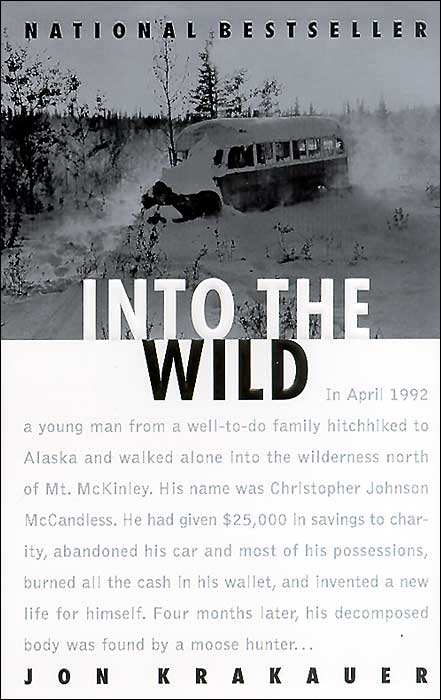
into the wild

Where to start? I can only say that as I flipped through the pages of this truly journalistic endeavor last January, I found (as many will and have) that place in my bones that thirsts for this freedom.

This book, Into the Wild, was written about a young man, Chris McCandless. This young man grew up in a middle-class neighborhood in Virginia with parents whose lives succumbed to the ‘dream’ which kept them working into the morning when they would wake to start again. This young man seemed to develop at a young age a distaste for the unnecessary and a hunger for the most raw qualities of life. Only at his parents insistence did he consent to go to college, where he continued his pursuit of life in its mystical, raw form. But, after college he decided to adventure. An adventure (as I have gathered) about which many fantasize and few find.

It seems like Chris’ purpose was more in getting lost in adventure than finding anything at all. I got caught up in the intrigue, the shock of decisions that thrust a fist at culture – at norms and white picket fences. Intrigued… but sadly stirred by each desperate page of Chris’ story.

You see, at the end of it all, Chris McCandless found death in his adventure’s end in Alaska. The brilliant works of Tolstoy and Thoreau his only companions, this young man disappeared from this world.

Don’t we all wish we could ask him now, “Was it worth your life to go into the wild?” … but I would want to know, “Was it worth souls?” Granted, I have no idea the condition of Chris’ heart when he died. But, I would still want to know if he felt like his life happened for a reason beyond his desire to live it.

When we decide to give up everything for adventure – to live in the rawest form of life we can find – we are still no closer to true life. Unless… well, unless you purpose yourself into the wild for the sake of something greater than yourself.

For the sake of the Gospel, perhaps?

the fall of Prince Myshkin


He did fall quite literally. But, I don’t see how he could be anything but elevated as a result of his conviction and love for the broken. Yet, as I read now, he is the brunt of gossip and turned-up noses. Without the slightest ill intention, Prince Myshkin watched in horror as his future unfolded in the angry conversation of two women.

Corruption fell upon the ‘upper crust of Russian society’ and Myshkin had not a hint of hesitation – he would stand in for a crazed, deceitful, and broken woman. He would suffer and sacrifice on her account, though he would gain nothing and lose the love of his life.

This story is no less captivating on page 527 than when I began. The way Prince Myshkin receives and comforts this battered woman is almost like an adoption.

Tonight the message at the gathering was about adoption. We looked at Paul’s letter to the church in Galatia… his words to remember our place. We are, through Christ, made sons and daughters of a holy and eternal family. Not only do we experience redemption and cleansing from our sins, but we also have an inheritance. We are heirs to the greatest, most substantial estate ever there was.

I was pondering on these things. I was thinking about adoption and how I understand a child to become part of a family where s/he was once a stranger. But, I realized our heavenly adoption is of severely greater consequence. God wanted us to be a part of his family so bad that he was willing to pay any cost. He sacrificed his own son so that he could call us his children. What family do you know that would sacrifice one of their own to rescue even one orphan child? Only God has this capacity to love.

So, I’m eager to turn the pages and see the fate of dear Myshkin. Though I’m just sure he will be shunned by friend and foe alike, I am rooting for this underdog. He did exactly what was ill-suited, in poor taste, lowly, and base in the world’s eyes. He made himself nothing.

How will I appear base to the world?

the small things

Today, after several meetings and several hours working at the computer, I walked out into the bold, Southern sun. What a joy to see Spring leap so decidedly and quickly. There is no hesitation about it.

Tonight I sat with eight of the most wonderful sixth grade girls in all of Austin. We read the account of Jesus’ death, burial, and resurrection. My, what minds they have! I danced inside, as David did, as I listened to their wisdom and insight. Prince Myshkin (from Dostoevsky’s “The Idiot”) is deeply convinced that much is lost when children are not invited into the conversation and I wholeheartedly agree!

“Why did the people choose the killer Barabbas instead of Jesus who was perfect,” they asked. The group pondered and decided that the crowd was jealous, suspicious, and misunderstanding of who Jesus was.

Hmm. It’s foolish to not see the similarities today. Those who are positively convinced that Jesus is a farce, Christianity a crutch. We have missed the message; we have misunderstood what is salvation. At exactly no cost we are offered grace, provision, and LIFE.

What a story to tell!

And the small things, like the hope in these 11-year-old eyes, are more than amazing.

Prince Myshkin

Lately, I’ve been falling asleep in the cities of Petersburg and Moscow. I’ve been dreaming of princes and inheritances and wealthy families and love’s irony. All this because I’m in the middle of Fyodor Dostoevsky’s famous work, “The Idiot.”

This prince, dubbed the idiot in the first pages, has officially stolen my heart. What a character he is! Social mores have no consequence and certainly no hold, though I am at times perplexed by the flush in his cheeks. He is a man without presumption.

I cannot follow in this bold claim. I see how alltogether presumptuous I am. Ironical that though I am fully aware of this tendency, I still live with a certain snobbish air. How ridiculous it sounds even as I say it! But, it is sadly all too true.

I am on page 181 and the adventure could not be long enough for me. Have you ever absorbed some form of art and desired so intensely to understand it completely that you rush to finish? I’ll try to explain. Whenever I read a C.S. Lewis novel or listen to one of my favorite Nickel Creek songs, I am impatient for it to finish so that it can be known – part of my life repertoire. It’s like eating a delicacy, so good that you stuff your mouth, only to find that it’s over too soon and you now have indigestion. I suppose it’s as hard to articulate as it is for me to explain.

I just know that my desire for art, philosophy, and literature seems at times to jump from book to book, page to page in a kind of ADD rhythm. I can hardly focus on the fascinating work in front of me, but upon finishing all I really want to do is go back and absorb it all over again.

If literature were chocolate, I would always have a sweet, sticky face and a tummy-ache. I shall try my best to enjoy Prince Myshkin to the most while I have him.

Men Without Chests… and the miseducation of children

The book starts with an eloquent description of an elementary text book.

An interesting object on which to base an argument, but C.S. Lewis does just that in his opening of what was originally a lecture series titled “The Abolition of Man” (the subtitle reads: Reflections on education with special reference to the teaching of English in the upper forms of schools).

With all the nebulous talk of improved education among scholars and legislators, I have long wondered if there is truth to the fabled “subliminal message.” After painstakingly reading one of Lewis’ most controversial books, I submit that merely wondering at such a possibility is just as damaging as promoting it.

C.S. Lewis refers to the elementary text in question as The Green Book and sets out to argue that the authors teach very little about literature. In fact, The Green Book essentially seeks to ‘debunk’ the existence of any objective value.

Now, that may not strike you as dangerous or deceiving, but this ideological shift is not so plainly described by the authors. The example Lewis gives from their book cites the “well-known story of Coleridge at the waterfall” (of which I knew little) where one tourist called a waterfall sublime and the other pretty. Lewis writes that Coleridge, a renowned poet, mentally endorsed the first description and was disgusted in the second. This is the excerpt from The Green Book:

‘When a man said This is sublime, he appeared to be making a remark about the waterfall… Actually … he was not making a remark about the waterfall, but a remark about his own feelings. What he was really saying was really I have feelings associated in my mind with the word “sublime,” or shortly, I have sublime feelings.’

Keep in mind, the young mind for which this text is intended has little reference for such a proposition. Boys and girls are more concerned with receiving good marks then defending the notion of objective value. And herein lies the danger.

The authors (possibly unintentionally) are making no claims about literature. They are instead suggesting that human sentiment is contrary to reason and ought to be eradicated. Interestingly enough, as Lewis points out, to say something is reasonable or unreasonable means that there must be a standard to make that judgment.

And now, by way of this disastrous summary of Lewis’ first chapter, we start to see the development of Men Without Chests. Assuming objective value is unreasonable, Lewis moves toward the logical question: On what grounds does any value exist in the world and what force would move me to protect this fleeting, traditional idea?

Interestingly enough, though this idea is purported in institutions across the country, the opposite is expected in life’s vernacular. Students might be taught to disregard value and view all things in relativistic terms, yet when it is time to preserve society, all are called to sacrificially stand on the high grounds of character. Lewis writes that youth are encouraged to strive to be people of character, while being conditioned to believe such traits are unreasonable.

“In a sort of ghastly simplicity,” Lewis writes, “we remove the organ and demand the function. We make men without chests and expect of them virtue and enterprise.”

Strip life of sentiment and you are left with a skeleton. Relativism may be trendy and “progressive,” but this kind of progress would lead straight to humankind’s demise. There will simply always be those who make the rules and those that follow them. If the rule makers decide life is void of sentiment, they will certainly reap the benefits of this stale standard.

Dangerous? yes. Deceptive? yes. Merely wondering at the possibility of ‘value debunked’ is just as damaging as promoting it. Can we recapture the necessary distinction of humanity? Can we hold firm the objective value intrinsic to our created nature? I believe we were born for such a purpose.

Maybe someone should write a children’s book about it.

loving humility is the strongest of all

At some thoughts one stands perplexed – especially at the sight of men’s sin – and wonders whether one should use force or humble love. Always decide to use humble love. If you resolve to do that, once and for all, you can subdue the whole world. Loving humility is marvelously strong, the strongest of all things, and there is nothing else like it.

Fyodor Dostoevsky

So, this is what Mr. Dostoevsky has to say about humility. I guess I might be understanding this… maybe.

In this whole season of dependence, I have been overwhelmed with the sight of mankind’s sin. My own and those I share with humanity. It seems to suck the life right from your marrow. All my courage and stalwart strength turns to something like mush that lands with a splash at my feet. It’s hard to know how to fight if the enemy is so large. I guess Dostoevsky has something right here – loving humility is marvelously strong and there is nothing like it.

There is nothing like it because we are not capable of it. But, oh that the Lord would grant us a taste that we could share. That we might know that the most marvelous display of loving humility was the completed task of His sacrifice.